Most of us learn Spring backwards: first Spring Boot, which starts an application with one annotation, and then, the day something breaks, we discover there was a container, proxies and transactions underneath that nobody ever explained to us.
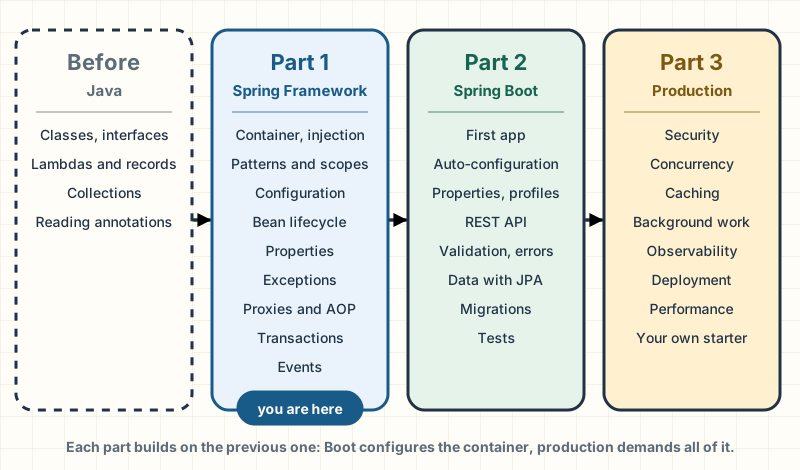
This series goes in order. There's no Spring Boot in this first part: just Spring Framework on its own, the container that builds your application, with every term defined when it shows up. All you need is to know how to program in Java.
I compiled and tested all the code with Spring Framework 7.0.10: I checked every behavior I describe with a test, and the outputs you see are the ones I got.
Why Spring exists
Picture this: it's 2002 and you're asked to build the part of the system that records an order. In enterprise Java, the standard answer was J2EE (Java 2 Platform, Enterprise Edition), Java's set of specifications for enterprise applications, and the business logic went into an EJB (Enterprise JavaBean).
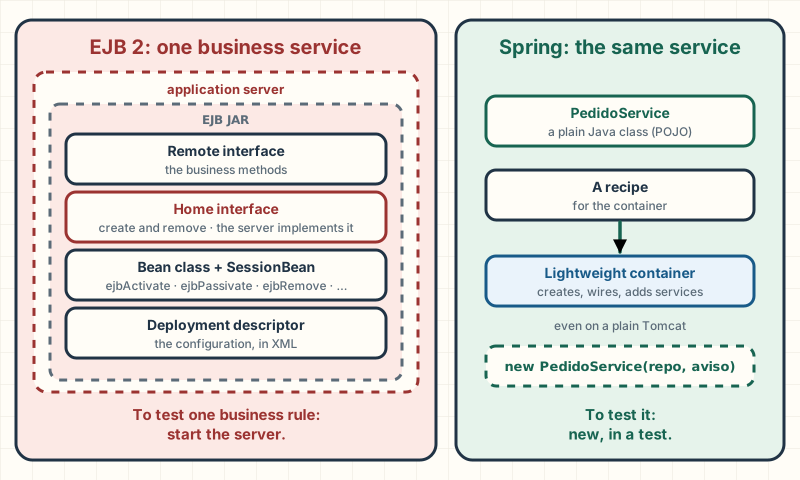
An EJB with remote access wasn't one class. It was several pieces the specification required (The J2EE 1.4 Tutorial):
a remote interface, with the business methods;
a home interface, to create and remove the bean, which the server implemented (Java EE 6 API, EJBHome);
the bean class, which also implemented SessionBean: four methods the server used to notify it about its lifecycle (Java EE 6 API, SessionBean);
a deployment descriptor in XML;
and all of it packaged into an EJB JAR, deployed on an application server.
A business service before and after Spring: from five pieces tied to the server to a plain class you test with new.
Since the server implemented the home interface, testing a business rule meant starting the server.
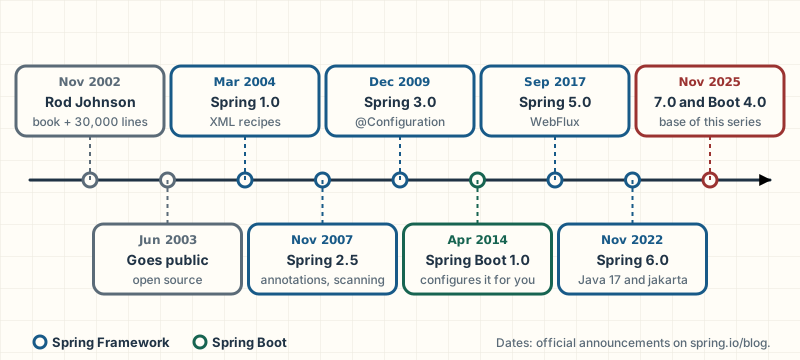
In November 2002, Rod Johnson published Expert One-on-One J2EE Design and Development, a book that came with about 30,000 lines of framework code. His readers convinced him to turn that code into an open source project, which went public in June 2003. The name, Spring, signaled a fresh start after the "winter" of traditional J2EE (Rod Johnson, The Origins of a Project and a Name).
The idea fits in one sentence. Your business logic goes into POJOs (Plain Old Java Objects): ordinary Java classes that don't extend or implement anything from the framework. And a lightweight container creates them, wires them together and adds from the outside what the server used to demand, such as transactions.
Spring 1.0 shipped on March 24, 2004 with exactly that: a container with setter and constructor injection, AOP, a layer over JDBC and declarative transactions "applicable to any POJO", on a plain Tomcat (Spring Framework 1.0 Final Released). Today's reference sums it up: Spring was born "in response to the complexity of the early J2EE specifications" (Spring Framework Reference, 7.0).
Why it's still relevant
Every generation of Spring kept the container and the POJOs, and changed how you write the recipes and what surrounds them:
More than twenty years with the same idea: the way you write the recipes changes, the container doesn't.
The dates come from the official announcements on the Spring blog. Spring Framework 7.0, released on November 13, 2025, is the foundation of Spring Boot 4.0, which shipped a week later.
Note: On this site, the backend is a Spring Boot 4.1.2 application, built on the same Spring Framework 7 this guide covers.
What you gain and what you pay
What you gain:
Your code doesn't depend on the framework. A class that receives its dependencies in the constructor can be tested with new, with no server and no Spring.
Cross-cutting concerns are declared. A transaction is an annotation on a method, not a block of open, commit and roll back in every one of them.
Individual standards, not the whole platform. Spring integrates selected specifications, such as Servlet, JPA, Bean Validation or JMS (Spring Framework Reference, 7.0).
What you pay:
A learning curve. Container, scopes, proxies, propagation: lots of concepts before you can explain why something fails.
The "magic". Part of the behavior lives in objects the container puts in front of yours, and when it fails, it fails in strange ways. I reproduce that with tests in the section on proxies.
Startup. The container does its work at startup, so that errors show up early. That takes time, and Part 3 measures it.
Major migrations. Spring 6.0 dropped the javax packages for jakarta and raised the minimum to Java 17 (Spring Framework 6.0 goes GA). Moving to a new generation is planned work.
What you'll learn and in what order
First the container, then Boot, which configures it, and finally what production demands.
First the container without Spring Boot; then Boot, which doesn't replace anything from Part 1 but configures it for you; and finally, what production demands.
Before you start, you should be comfortable with:
Object-oriented Java: classes, interfaces and implementations, and reading an annotation like @Override.
Collections, and the difference between an interface and its implementation, which is the foundation of dependency injection: Java Collections: List Is Not ArrayList.
Your working environment
To follow the guide, you'll build your own project with the pom.xml and the classes I show.
A JDK 21
Spring Framework 7 requires Java 17 at minimum (Spring Framework 7.0 General Availability); in this series I use Java 21, the version this site's backend runs on. To check which one you have:
java -version
If the first line doesn't say 21 or higher, install a JDK 21 from any vendor, for example Eclipse Temurin.
An IDE
IntelliJ IDEA: since 2025.3 it's a single product, with no Community or Ultimate edition, and the core features are free (JetBrains, IntelliJ IDEA as a unified product). It comes with Maven built in.
Visual Studio Code with Microsoft's Extension Pack for Java.
A Maven project
Maven downloads the project's libraries (its dependencies), compiles the code and runs the tests. Create a new Maven project from your IDE. You don't need to install Maven if the project includes the Maven Wrapper: two scripts that download the version pinned in .mvn/wrapper/maven-wrapper.properties and run it from there (Apache Maven Wrapper). You generate it once with mvn wrapper:wrapper, from the IDE, and from then on:
./mvnw test # macOS and Linuxmvnw.cmd test # Windows
Spring is split into modules (spring-context, spring-jdbc, spring-tx…) that must all be on the same version. That's what a BOM (Bill of Materials) is for: a list of versions you import once in the pom.xml.
pom.xml
<dependencyManagement> <dependencies> <!-- Un BOM fija la versión de TODOS los módulos de Spring a la vez: abajo, las dependencias van sin <version>. --> <dependency> <groupId>org.springframework</groupId> <artifactId>spring-framework-bom</artifactId> <version>7.0.10</version> <type>pom</type> <scope>import</scope> </dependency> <dependency> <groupId>org.junit</groupId> <artifactId>junit-bom</artifactId> <version>6.0.3</version> <type>pom</type> <scope>import</scope> </dependency> </dependencies></dependencyManagement>
With the BOM, Spring dependencies go without a <version>. To get started, one is enough:
pom.xml
<!-- El contenedor: beans, ApplicationContext, anotaciones. --><dependency> <groupId>org.springframework</groupId> <artifactId>spring-context</artifactId></dependency>
7.0.10 is the version that ships with Spring Boot 4.1.2, the one this site's backend uses. The second BOM pins JUnit's version; for the tests, add junit-jupiter and assertj-core with <scope>test</scope>. The database dependencies come in the section on exceptions.
Your first app with the container
PrimeraApp.java
@Configurationpublic class PrimeraApp { record Saludo(String texto) {} @Bean Saludo saludo() { return new Saludo("Hola, Spring"); } public static void main(String[] args) { try (var contexto = new AnnotationConfigApplicationContext(PrimeraApp.class)) { System.out.println(contexto.getBean(Saludo.class).texto()); } }}
I take the pieces apart in the next section. Run the main from your IDE: if Hola, Spring shows up in the console, your environment is ready.
Inversion of control and dependency injection
There's a question worth asking about any class you write: who decides which objects it works with? It sounds like a philosophy question. It's the question that separates code you can change and test from code you can't, and it's the reason Spring exists.
Let's answer it with the order store that comes with us through the whole series. When someone buys, PedidoService saves the order and notifies the customer by email. The code keeps the Spanish names I tested it with: a Pedido is an order, a Notificador is a notifier and registrar means to record. The first version almost all of us write is this one:
PedidoServiceAcoplado.java
public class PedidoServiceAcoplado { private final RepositorioEnMemoria repositorio = new RepositorioEnMemoria(); private final NotificadorCorreo notificador = new NotificadorCorreo(); public void registrar(Pedido pedido) { repositorio.guardar(pedido); notificador.enviar(pedido.correoCliente(), "Recibimos tu pedido " + pedido.numero()); }}
It works. And it has a problem you don't see until you try to test it: the class decided on its own that it notifies by email, with NotificadorCorreo, and built that notifier itself with new. There's no way to call registrar() without running the real notifier. I checked it with a test: testing the service sends the email, every time.
If tomorrow you want to notify by SMS, you have to open this class and edit it. If you want to test it without sending emails, you can't. The new tied you to a concrete implementation.
Three ways to get a dependency
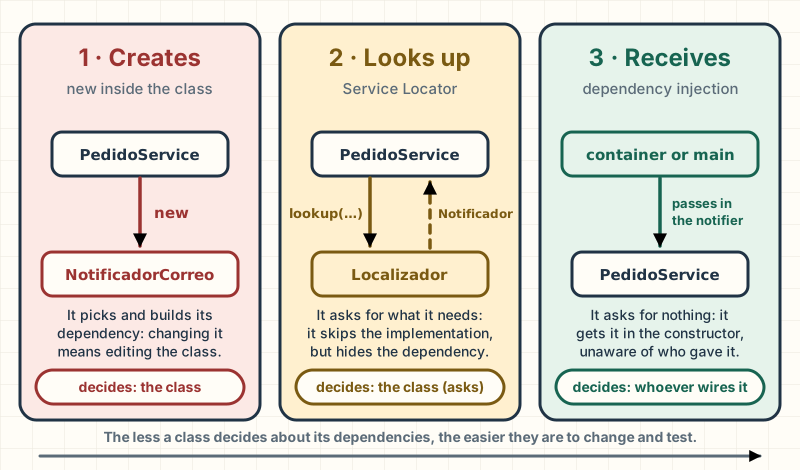
A dependency is any object a class needs to do its job. PedidoService needs two: somewhere to save and some way to notify. There are three ways to get them, and what changes between them is who decides:
What changes between the three isn't the method's code, it's who picks the notifier.
We already saw the first one: the class creates what it needs. The second is a pattern with a name of its own, the Service Locator: a global registry where each class goes to look up what it needs.
Localizador.java
public final class Localizador { private static final Map<Class<?>, Object> servicios = new HashMap<>(); public static <T> void registrar(Class<T> tipo, T servicio) { servicios.put(tipo, servicio); } public static <T> T buscar(Class<T> tipo) { return tipo.cast(servicios.get(tipo)); }}
PedidoServiceConLocalizador.java
public class PedidoServiceConLocalizador { public void registrar(Pedido pedido) { Localizador.buscar(RepositorioPedidos.class).guardar(pedido); Localizador.buscar(Notificador.class) .enviar(pedido.correoCliente(), "Recibimos tu pedido " + pedido.numero()); }}
It's an improvement: the service no longer knows the notifier sends emails, it just asks for "a Notificador", and in a test you can register a fake one. But the constructor is empty: from the outside, nobody knows this class needs a repository and a notifier. If you forget to register one, you only find out when you run it, with a NullPointerException in the middle of registrar(). The dependency is still there, just hidden.
The third way is the one that matters. The class receives what it needs in the constructor and decides nothing:
Before
PedidoServiceAcoplado.java
public class PedidoServiceAcoplado { private final RepositorioEnMemoria repositorio = new RepositorioEnMemoria(); private final NotificadorCorreo notificador = new NotificadorCorreo(); public void registrar(Pedido pedido) { repositorio.guardar(pedido); notificador.enviar(pedido.correoCliente(), "Recibimos tu pedido " + pedido.numero()); }}
After
PedidoService.java
public class PedidoService { private final RepositorioPedidos repositorio; private final Notificador notificador; public PedidoService(RepositorioPedidos repositorio, Notificador notificador) { this.repositorio = repositorio; this.notificador = notificador; } public void registrar(Pedido pedido) { repositorio.guardar(pedido); notificador.enviar(pedido.correoCliente(), "Recibimos tu pedido " + pedido.numero()); }}
Now PedidoService works with any RepositorioPedidos and any Notificador: interfaces, not concrete classes. And the constructor says out loud what the class needs in order to exist.
What inversion of control is
In the first two versions, the class is in control: it picks its notifier, either by building it or by asking for it. In the third, that control has been inverted: whoever builds the class holds it. Hence the name.
Inversion of control (IoC) is a more general principle than this example: instead of your code calling the framework, the framework calls your code. It's also known as the Hollywood principle: "don't call us, we'll call you" (Martin Fowler, InversionOfControl). You've already used it, even if you never named it: when you write a @Test method, you never write the main that runs it. JUnit finds it and calls it when it's time. That's precisely the difference between a library, which you call, and a framework, which calls you.
Dependency injection (DI) is one concrete way to apply that principle to dependencies: the class declares them in its constructor and someone from the outside injects them when creating it. The Spring reference defines it like this: objects declare their dependencies only through constructor arguments, arguments to a factory method, or properties set after the object is constructed, and the container injects them, which is the inverse of the object itself controlling their creation or lookup "by using direct construction of classes or a mechanism such as the Service Locator pattern" (Spring Framework Reference, 7.0).
The usual mistake: thinking the Service Locator is a form of dependency injection because "there's no new anymore". It isn't: the class is still asking. With injection it asks for nothing, and that's why it doesn't depend on the locator either.
Dependency injection without Spring
Dependency injection is a pattern, not a library. Somebody has to do the new, and in an app without a framework that somebody is main:
AppManual.java
RepositorioPedidos repositorio = new RepositorioEnMemoria();Notificador notificador = new NotificadorCorreo();PedidoService pedidos = new PedidoService(repositorio, notificador);pedidos.registrar(new Pedido(42, "ana@example.com"));
And the test, which was impossible before, is now trivial. You build the service with a fake notifier that, instead of sending emails, writes down what it was asked to send:
PedidoServiceTest.java
@Testvoid registrarAvisaAlCliente() { var notificador = new NotificadorFalso(); var pedidos = new PedidoService(new RepositorioEnMemoria(), notificador); pedidos.registrar(new Pedido(42, "ana@example.com")); assertThat(notificador.enviados()) .containsExactly("ana@example.com: Recibimos tu pedido 42");}
No Spring, no mail server, in milliseconds.
So why do we want Spring? With three classes, that main is three lines. In a real application it's hundreds of classes, and wiring them by hand becomes a program of its own: you have to create them in the right order, decide which ones are shared and which aren't, close connections on shutdown, swap pieces depending on the environment. That work is exactly what the Spring container does.
The container: a factory that follows your recipes
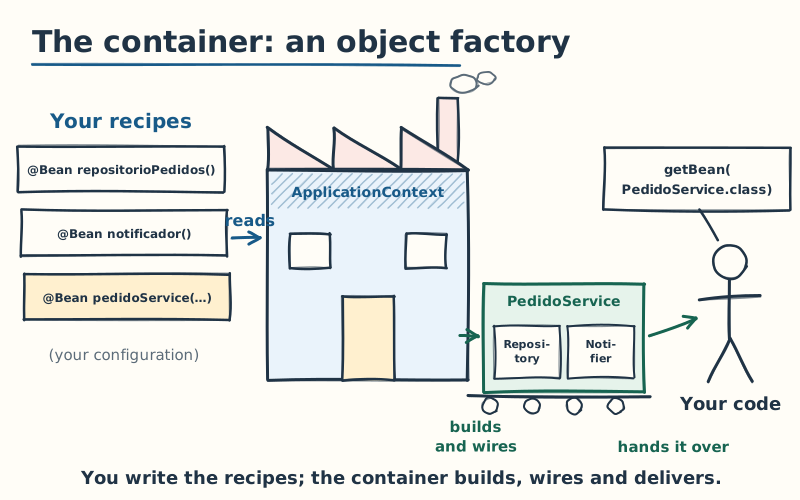
You write the recipes; the container builds each piece, wires them together and hands you the finished object.
The Spring container is the object that creates, wires and manages your application's objects. In code you'll see it as ApplicationContext. Each object the container manages is called a bean: an ordinary Java object, except the container created it instead of you.
For the container to know what to create, you give it recipes. They're the same three lines from the hand-written main, each in its own method:
ConfiguracionPedidos.java
@Configurationpublic class ConfiguracionPedidos { @Bean RepositorioPedidos repositorioPedidos() { return new RepositorioEnMemoria(); } @Bean Notificador notificador() { return new NotificadorCorreo(); } @Bean PedidoService pedidoService(RepositorioPedidos repositorio, Notificador notificador) { return new PedidoService(repositorio, notificador); }}
@Configuration marks the class as a recipe book, and each @Bean is a recipe: whatever the method returns is the bean. If a recipe has parameters, like pedidoService(...), the container looks among its beans for one of each type and passes it in. That's the injection.
Step 12 of 12: And the service uses the notifier it received, without knowing who picked it or who created it.
Your code creates the container and passes it the configuration class. No bean exists yet.
The recipe book is a bean too: the first of your beans the container creates is ConfiguracionPedidos itself.
Now it follows the recipes. The first one has no parameters: it calls it as is.
The method does the new and returns the object. The container stores it as the repositorioPedidos bean.
Second recipe, same path.
There are two beans now: a repository and a notifier.
The third recipe asks for a RepositorioPedidos and a Notificador. The container looks among its beans by type and passes in the two it just created. This is the injection.
PedidoService is born with its dependencies inside. All of this happened at startup, before your code asked for anything.
Only now does your code ask for the service. Nothing gets created: the container already had it built.
It hands it back, ready to use.
From here on it's plain Java: you call a method on an object.
And the service uses the notifier it received, without knowing who picked it or who created it.
Two details of that sequence aren't obvious. The first is that the container creates the singleton beans at startup, not when you ask for them. It does that on purpose: if a recipe is wrong, you'd rather find out when the application starts than at three in the morning, when someone asks for that bean for the first time (Spring Framework Reference, 7.0). I checked it with a test.
The second detail is what doesn't appear: PedidoService doesn't import anything from Spring. It's the same class we wired by hand in main and in the test. That's why changing the wiring doesn't touch the class. Another recipe book is enough, for example a test one with the fake notifier:
ContenedorTest.java
@Configurationstatic class ConfiguracionDePrueba { @Bean RepositorioPedidos repositorioPedidos() { return new RepositorioEnMemoria(); } @Bean NotificadorFalso notificador() { return new NotificadorFalso(); } @Bean PedidoService pedidoService(RepositorioPedidos repositorio, Notificador notificador) { return new PedidoService(repositorio, notificador); }}
Through the constructor, not the field
There's another way to ask Spring for dependencies that you'll find in a huge amount of code, because it's shorter: annotating the fields with @Autowired.
PedidoServiceConCampo.java
@Componentpublic class PedidoServiceConCampo { @Autowired private RepositorioPedidos repositorio; @Autowired private Notificador notificador; public void registrar(Pedido pedido) { repositorio.guardar(pedido); notificador.enviar(pedido.correoCliente(), "Recibimos tu pedido " + pedido.numero()); }}
Inside the container it works: Spring creates the object and then fills in the fields through reflection. Outside of it, a test that creates the class with new finds the fields set to null:
PedidoServiceConCampoTest.java
@Testvoid fueraDelContenedorLosCamposQuedanEnNull() { var servicio = new PedidoServiceConCampo(); assertThatThrownBy(() -> servicio.registrar(new Pedido(42, "ana@example.com"))) .isInstanceOf(NullPointerException.class);}
With constructor injection that can't happen: the compiler won't let you create the object without its dependencies. It's what the Spring team recommends, for three reasons (Spring Framework Reference, 7.0):
Fields can be final: the object is immutable, and nobody swaps its notifier halfway through.
Required dependencies are never null: if one is missing, the object doesn't get created.
The object comes out complete: whoever receives it never sees one that's half built.
Also, if a class the container creates on its own has a single constructor, you don't need to annotate it with @Autowired: Spring uses it on its own. PedidoService doesn't even need that, because your recipe creates it with new; you'll see the rule at work in ServicioEscaneado, further down.
What to take with you:
Inversion of control: the framework calls your code, not the other way around. With dependencies, it means the class stops choosing them.
Dependency injection: the class declares what it needs in the constructor and someone from the outside provides it. The Service Locator isn't that: there, the class is still asking.
Container and bean: the ApplicationContext creates, wires and manages your objects; each of them is a bean, and by default the singletons are created at startup.
Through the constructor: final fields, nothing null, complete objects, and classes you can test without Spring.
Going deeper
the name "dependency injection" was settled on in 2004 by Martin Fowler and the authors of IoC containers, precisely because he found "inversion of control" too generic a term (Martin Fowler, Inversion of Control Containers and the Dependency Injection pattern), where he also compares it with the Service Locator.
The container resolves the parameters of a constructor or a @Bean method by type. When there's more than one candidate of the same type you need to disambiguate, and we'll get to that later, with @Qualifier and @Primary.
A constructor cycle, where A needs B and B needs A, has no solution: neither can be created first. The container detects it at startup and throws BeanCurrentlyInCreationException. In Spring without Boot, the same cycle through fields or setters does start, and that's why it hides a design problem the constructor forces you to see.
Setter injection still has its place, but only for optional dependencies that have a reasonable default value inside the class.
The patterns behind Spring
Spring uses classic patterns, the ones from the Design Patterns book known as "GoF" (Gang of Four). Careful: the book's pattern and Spring's version sometimes share a name without being the same thing.
Factory: the container is a factory
A factory is an object whose job is to create other objects, so whoever uses them doesn't need to know how they're built. Spring has two levels:
BeanFactory, the basic interface: it creates beans and wires them.
ApplicationContext, which extends it and adds AOP, events, internationalized messages and web contexts (Spring Framework Reference, 7.0).
A plain BeanFactory doesn't detect BeanPostProcessors, the pieces that process the annotations and create the proxies (Spring Framework Reference, 7.0). I checked it with a test: a DefaultListableBeanFactory only creates the bean when you ask for it and doesn't run its @PostConstruct; an ApplicationContext creates it at startup and does run it. That's why the official recommendation is to use an ApplicationContext unless you have a good reason not to.
Each @Bean method is also a small factory, a factory method: Spring 3.0 introduced them as "annotated factory methods" (Spring Framework 3.0 goes GA). And when creating a bean takes logic of its own, there's FactoryBean<T>, a bean whose job is to make another one:
FabricaNotificador.java
public class FabricaNotificador implements FactoryBean<Notificador> { private final String canal; public FabricaNotificador(String canal) { this.canal = canal; } @Override public Notificador getObject() { return canal.equals("sms") ? new NotificadorSms() : new NotificadorCorreo(); } @Override public Class<?> getObjectType() { return Notificador.class; }}
When you ask for it, the container doesn't give you the factory but what it makes. To get the factory itself, you put & in front of the name (Spring Framework Reference, 7.0):
FabricasTest.java
@Configurationstatic class ConFabrica { @Bean FabricaNotificador notificador() { return new FabricaNotificador("sms"); }}@Testvoid elContenedorEntregaElProductoDeLaFabrica() { try (var contexto = new AnnotationConfigApplicationContext(ConFabrica.class)) { assertThat(contexto.getBean(Notificador.class)).isInstanceOf(NotificadorSms.class); assertThat(contexto.getBean("notificador")).isInstanceOf(NotificadorSms.class); assertThat(contexto.getBean("¬ificador")).isInstanceOf(FabricaNotificador.class); }}
Singleton: one per container, not one per class
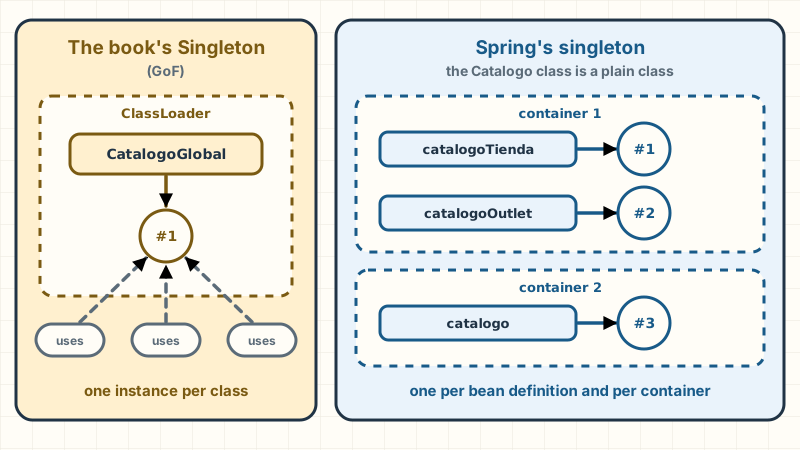
The book's Singleton is a class that guarantees on its own that only one instance exists: it hides its constructor and keeps the instance in a static field. In Spring, the class is an ordinary one, and the container is what decides there's only one, because singleton is every bean's default scope:
Before
CatalogoGlobal.java
public final class CatalogoGlobal { private static final CatalogoGlobal INSTANCIA = new CatalogoGlobal(); private CatalogoGlobal() {} public static CatalogoGlobal instancia() { return INSTANCIA; }}
After
ConfiguracionCatalogo.java
@Configurationpublic class ConfiguracionCatalogo { @Bean Catalogo catalogo() { return new Catalogo(); }}
What "only one" means changes too. The book's is one per ClassLoader (the JVM component that loads classes): in practice, one per class. Spring's is one per container and per bean definition (Spring Framework Reference, 7.0).
The book's Singleton is one per class; Spring's is one per recipe and per container.AlcancesTest.java
@Configurationstatic class DosCatalogos { @Bean Catalogo catalogoTienda() { return new Catalogo(); } @Bean Catalogo catalogoOutlet() { return new Catalogo(); }}@Testvoid elSingletonDeSpringEsUnoPorDefinicionDeBean() { try (var contexto = new AnnotationConfigApplicationContext(DosCatalogos.class)) { var tienda = contexto.getBean("catalogoTienda", Catalogo.class); var outlet = contexto.getBean("catalogoOutlet", Catalogo.class); assertThat(tienda).isNotSameAs(outlet); assertThat(contexto.getBean("catalogoTienda")).isSameAs(tienda); }}@Testvoid elSingletonDeSpringEsUnoPorContenedor() { try (var uno = new AnnotationConfigApplicationContext(ConfiguracionCatalogo.class); var otro = new AnnotationConfigApplicationContext(ConfiguracionCatalogo.class)) { assertThat(uno.getBean(Catalogo.class)).isNotSameAs(otro.getBean(Catalogo.class)); }}
What doesn't change is that the singleton is shared: everyone who asks for it gets the same object, and in a web application that means every request at once. That's why the reference's rule is singleton for stateless beans and prototype for stateful ones (Spring Framework Reference, 7.0).
The usual mistake: storing something that belongs to one customer in a singleton's field. This calculator remembers the discount of whoever used it last:
CalculadoraConDescuento.java
public class CalculadoraConDescuento { private int descuento; public void aplicarDescuento(int porcentaje) { this.descuento = porcentaje; } public int total(int subtotal) { return subtotal - subtotal * descuento / 100; }}
Ana and Luis get the same object; Luis applies his discount after Ana, and Ana pays without hers:
AlcancesTest.java
@Testvoid elDescuentoDeAnaSeLoLlevaLuis() { try (var contexto = new AnnotationConfigApplicationContext(ConCalculadora.class)) { var paraAna = contexto.getBean(CalculadoraConDescuento.class); var paraLuis = contexto.getBean(CalculadoraConDescuento.class); paraAna.aplicarDescuento(10); paraLuis.aplicarDescuento(0); assertThat(paraAna.total(1_000)).isEqualTo(1_000); }}
The fix is to hold no state: the discount comes in as a parameter of total.
Prototype: a new one every time
An order draft, the list a customer puts together before confirming, has to be one per customer. That's what the prototype scope is for: every time you ask for the bean, the container runs the recipe and gives you a new one.
ConfiguracionAlcances.java
@Configurationpublic class ConfiguracionAlcances { @Bean CalculadoraEnvio calculadoraEnvio() { return new CalculadoraEnvio(); } @Bean @Scope("prototype") BorradorPedido borradorPedido() { return new BorradorPedido(); }}
Three requests to a singleton and to a prototype
Container
CalculadoraEnvio #1 (discarded)
BorradorPedido recipe
Customer A
CalculadoraEnvio #1 (discarded)
BorradorPedido #1
Customer B
CalculadoraEnvio #1 (discarded)
BorradorPedido #2
Customer C
CalculadoraEnvio #1 (discarded)
BorradorPedido #3
Step 8 of 8
Step 8 of 8: When the container closes, Spring destroys the singleton it manages. It doesn't touch the drafts: cleaning them up is the job of whoever asked for them.
At startup, the container creates the CalculadoraEnvio singleton and keeps it. For the prototype it only has the recipe: no BorradorPedido exists yet.
Customer A asks for the calculator. Nothing gets created: the container hands over the one it already had.
Customer B asks for the same thing and gets the same object, #1.
And so does customer C. Three requests, a single object: that's why a singleton can't hold anything that belongs to one customer.
Now customer A asks for a BorradorPedido. With prototype, the container runs the recipe right then and hands over a new object.
Customer B asks for another one and gets another one: #2. Whatever A adds to their draft, B doesn't see.
Customer C gets #3. Notice that the container kept none of them: it handed them over and forgot about them.
When the container closes, Spring destroys the singleton it manages. It doesn't touch the drafts: cleaning them up is the job of whoever asked for them.
In the test, isSameAs checks that two references point to the same object, not that they're equal:
AlcancesTest.java
@Testvoid elSingletonEsUnoParaTodosElPrototypeUnoPorPedido() { try (var contexto = new AnnotationConfigApplicationContext(ConfiguracionAlcances.class)) { var calculadora1 = contexto.getBean(CalculadoraEnvio.class); var calculadora2 = contexto.getBean(CalculadoraEnvio.class); var calculadora3 = contexto.getBean(CalculadoraEnvio.class); assertThat(calculadora1).isSameAs(calculadora2).isSameAs(calculadora3); var borrador1 = contexto.getBean(BorradorPedido.class); var borrador2 = contexto.getBean(BorradorPedido.class); var borrador3 = contexto.getBean(BorradorPedido.class); assertThat(borrador1).isNotSameAs(borrador2); assertThat(borrador2).isNotSameAs(borrador3); }}
I checked the last step with a test too: Spring hands over a prototype and never sees it again, so it doesn't call its destruction methods (Spring Framework Reference, 7.0).
The prototype-inside-a-singleton trap
This cash register, a singleton, receives a draft in its constructor:
CajaConBorradorFijo.java
@Componentpublic class CajaConBorradorFijo { private final BorradorPedido borrador; public CajaConBorradorFijo(BorradorPedido borrador) { this.borrador = borrador; } public BorradorPedido nuevoPedido() { return borrador; }}
The container resolves a bean's dependencies once, when it creates it (Spring Framework Reference, 7.0). The register is created only once and gets only one draft; it doesn't matter that the draft is a prototype. Luis finds Ana's book in his order:
AlcancesTest.java
@Testvoid elSingletonRecibioUnSoloBorradorYLoComparteConTodos() { try (var contexto = new AnnotationConfigApplicationContext(ConCajas.class)) { var caja = contexto.getBean(CajaConBorradorFijo.class); caja.nuevoPedido().agregar("libro"); var deLuis = caja.nuevoPedido(); assertThat(deLuis.productos()).containsExactly("libro"); }}
The fix is to receive something that knows how to ask for a new draft every time: ObjectProvider<T>, which asks the container for the bean on every getObject(). With Caja, Luis's order starts empty.
Before
CajaConBorradorFijo.java
@Componentpublic class CajaConBorradorFijo { private final BorradorPedido borrador; public CajaConBorradorFijo(BorradorPedido borrador) { this.borrador = borrador; } public BorradorPedido nuevoPedido() { return borrador; }}
After
Caja.java
@Componentpublic class Caja { private final ObjectProvider<BorradorPedido> borradores; public Caja(ObjectProvider<BorradorPedido> borradores) { this.borradores = borradores; } public BorradorPedido nuevoPedido() { return borradores.getObject(); }}
There are also the request, session, application and websocket scopes, which only work in a web context (Spring Framework Reference, 7.0). They arrive with the web, in Part 2.
Proxy, Template Method and Observer, in one line each
Proxy: an object that stands in front of another and decides what happens before and after each call (proxies and AOP).
Template Method: a fixed skeleton with a gap for whatever changes, like JdbcTemplate (exceptions).
Observer: an object announces that something happened and others react; the reference uses that name for the container's events (Spring Framework Reference, 7.0) (events).
Pattern
In the book (GoF)
In Spring
Factory
an object that creates others
BeanFactory, ApplicationContext, each @Bean, FactoryBean
Singleton
the class guarantees one instance per ClassLoader
the container: one per bean definition and per container
Prototype
an object is created by copying a model one
the container runs the recipe again; it copies nothing
Proxy
a stand-in that controls access to the real one
the proxies for AOP, @Transactional, @Async…
Template Method
the skeleton lives in a superclass
JdbcTemplate and friends, with callbacks
Observer
a subject notifies its observers
ApplicationEventPublisher and @EventListener
What to take with you: everyone shares the singleton: never store a customer's state in it. For a prototype inside a singleton, ask for it with ObjectProvider.
Configuring the container: XML, scanning or classes
Spring reads the recipes in three ways, and you'll find all three in real code.
XML, the original way
In Spring 1.0, recipes were written in XML. These are the ones for ConfiguracionPedidos:
You load them with new ClassPathXmlApplicationContext("pedidos.xml"). The configuration lives outside the code, but classes are named as text: if you rename PedidoService, the compiler doesn't warn you and the error shows up at startup.
Component scanning
Since Spring 2.5 you can mark the class and let the container find it (Spring Framework 2.5 Released):
ServicioEscaneado.java
@Servicepublic class ServicioEscaneado { private final RepositorioPedidos repositorio; private final Notificador notificador; public ServicioEscaneado(RepositorioPedidos repositorio, Notificador notificador) { this.repositorio = repositorio; this.notificador = notificador; } public void registrar(Pedido pedido) { repositorio.guardar(pedido); notificador.enviar(pedido.correoCliente(), "Recibimos tu pedido " + pedido.numero()); }}
ConfiguracionEscaneo.java
@Configuration@ComponentScanpublic class ConfiguracionEscaneo {}
@ComponentScan with no parameters walks the package of the class that declares it and its subpackages (Spring Framework API, @ComponentScan), and registers every class marked with @Component or one of its specializations: @Service for the service layer, @Repository for the data layer and @Controller for the web (Spring Framework Reference, 7.0). It's the shortest way, at the cost of your class importing a Spring annotation.
Configuration classes
The third way, since Spring 3.0, is the @Configuration class with @Bean methods from the previous section. It works with any class, even the ones you didn't write: you can't put @Component on JdbcTemplate or a DataSource, but you can create them with @Bean. The usual approach is scanning for your own classes and @Bean for third-party ones.
When there are two candidates
The container resolves dependencies by type. If there are two beans of the same type, it doesn't guess:
ConfiguracionDosNotificadores.java
@Configurationpublic class ConfiguracionDosNotificadores { @Bean Notificador correo() { return new NotificadorCorreo(); } @Bean Notificador sms() { return new NotificadorSms(); } @Bean RepositorioPedidos repositorioPedidos() { return new RepositorioEnMemoria(); } @Bean PedidoService pedidoService(RepositorioPedidos repositorio, Notificador notificador) { return new PedidoService(repositorio, notificador); }}
NoUniqueBeanDefinitionException: No qualifying bean of type 'com.ejemplo.pedidos.Notificador'available: expected single matching bean but found 2: correo,sms
ConfiguracionTest.java
@Testvoid conDosCandidatosElContenedorNoArranca() { assertThatThrownBy(() -> new AnnotationConfigApplicationContext(ConfiguracionDosNotificadores.class)) .hasRootCauseInstanceOf(NoUniqueBeanDefinitionException.class) .rootCause() .hasMessageContaining("expected single matching bean but found 2: correo,sms");}
There are two ways to break the tie. @Primary marks the preferred one when nobody asks for another (Spring Framework Reference, 7.0):
ConfiguracionConPrimary.java
@Bean@PrimaryNotificador correo() { return new NotificadorCorreo();}@BeanNotificador sms() { return new NotificadorSms();}
@Qualifier chooses at the injection point. A bean's name is its default qualifier, so @Qualifier("sms") picks the sms bean:
since Spring 6.2 there's @Fallback, the inverse of @Primary: it marks beans that are only used if nothing else is left. And if there's no qualifier and no primary, Spring compares the parameter name with the bean names; since 6.1 that requires compiling with -parameters (Spring Framework Reference, 7.0). My project compiles without that option on purpose, so every tiebreak is written down in the code.
Profiles: one recipe per environment
On your machine you don't want to send real emails; in production, you do. A profile is a name that turns recipes on or off: @Profile("local") registers the bean only if the local profile is active (Spring Framework Reference, 7.0).
ConfiguracionPorAmbiente.java
@Configurationpublic class ConfiguracionPorAmbiente { @Bean @Profile("local") Notificador notificadorDeConsola() { return new NotificadorConsola(); } @Bean @Profile("produccion") Notificador notificadorDeCorreo() { return new NotificadorCorreo(); }}
Outside a test, you activate the profile with the spring.profiles.active property, for example -Dspring.profiles.active=produccion. With none active, the default profile applies (Spring Framework Reference, 7.0); since no recipe here is default, without a profile there's no notifier.
A bean's lifecycle
An email connection is opened when the object is ready and closed when the application shuts down. Without help, you'd have to call abrir() (open) and cerrar() (close) on every possible path. The container knows when each thing happens and lets you know: @PostConstruct runs once the bean has its dependencies, and @PreDestroy, before it's destroyed.
ConexionCorreo.java
public class ConexionCorreo { private final Bitacora bitacora; public ConexionCorreo(Bitacora bitacora) { this.bitacora = bitacora; bitacora.anotar("constructor: ya tiene sus dependencias"); } @PostConstruct void abrir() { bitacora.anotar("@PostConstruct: abre la conexión"); } public void enviar(String destino) { bitacora.anotar("en uso: envía a " + destino); } @PreDestroy void cerrar() { bitacora.anotar("@PreDestroy: cierra la conexión"); }}
The life of ConexionCorreo, from the recipe to shutdown
Recipe read
Created and injected
Initialized
In use
Destroyed
Bitacora (discarded)
ConexionCorreo (discarded)
Step 8 of 8
Step 8 of 8: Only then is the Bitacora destroyed, the bean the connection depended on.
The container starts and reads both recipes. No object exists yet.
ConexionCorreo needs a Bitacora in its constructor, so the container creates the Bitacora first.
The Bitacora has nothing to initialize: it's ready. Now the container calls the ConexionCorreo constructor and passes it the Bitacora. With constructor injection, creating and injecting are a single step.
With the dependencies in place, the container calls the @PostConstruct method: it opens the connection. This is the first moment the object can use what it received.
Then it goes through the BeanPostProcessors again, now in their after-initialization phase (one of them ran the @PostConstruct itself, in the before phase). They can return the bean as is or swap it for another object, such as a proxy.
The bean is ready. Your code asks for it with getBean and uses it: it sends an email. Everything before this happened at startup, before this moment.
When the container closes, the dependent bean is destroyed first: ConexionCorreo's @PreDestroy closes the connection while the Bitacora still exists.
Only then is the Bitacora destroyed, the bean the connection depended on.
The test checks that order (a Bitacora is a log book where each step writes an entry). Another one checks that, on destruction, the @PreDestroy of the bean that depends on another runs first.
CicloDeVidaTest.java
@Testvoid unBeanRecorreSuCicloDeVidaEnOrden() { var contexto = new AnnotationConfigApplicationContext(ConfiguracionCicloDeVida.class); var bitacora = contexto.getBean(Bitacora.class); contexto.getBean(ConexionCorreo.class).enviar("ana@example.com"); contexto.close(); assertThat(bitacora.entradas()).containsExactly( "constructor: ya tiene sus dependencias", "@PostConstruct: abre la conexión", "BeanPostProcessor: ve el bean ya inicializado", "en uso: envía a ana@example.com", "@PreDestroy: cierra la conexión");}
Three practical details:
@PostConstruct and @PreDestroy don't come from Spring. They used to be javax.annotation and shipped with the JDK, which removed them in Java 11; today they're jakarta.annotation and you add them with jakarta.annotation-api (Spring Framework Reference, 7.0). It's in the dependency block in the section on exceptions.
The InitializingBean and DisposableBean interfaces do the same thing, but the Spring team recommends the annotations, which keep your class from depending on Spring (Spring Framework Reference, 7.0).
Outside a web application, someone has to close the container for the @PreDestroy methods to run: the try-with-resources in the examples, or registerShutdownHook(), which closes it when the JVM shuts down (Spring Framework Reference, 7.0).
The usual mistake: using @PostConstruct for heavy work, like loading data or calling other services. It runs while the container is still creating beans, and the reference warns that it's meant for validating and preparing structures, with a risk of deadlocks during startup if it does more. For the heavy work it suggests SmartInitializingSingleton or a listener for the event that signals the context has finished starting (Spring Framework Reference, 7.0). There's another reason in transactions.
Going deeper
a BeanPostProcessor receives every bean the container creates, before and after its initialization methods (Spring Framework Reference, 7.0), and can return it as is or replace it: that's how the container puts a proxy in front of your bean. This one only notes that it saw it:
ObservadorDeBeans.java
public class ObservadorDeBeans implements BeanPostProcessor { private final ObjectProvider<Bitacora> bitacora; public ObservadorDeBeans(ObjectProvider<Bitacora> bitacora) { this.bitacora = bitacora; } @Override public Object postProcessAfterInitialization(Object bean, String nombre) { if (bean instanceof ConexionCorreo) { bitacora.getObject().anotar("BeanPostProcessor: ve el bean ya inicializado"); } return bean; }}
A lot of the "magic" is post-processors: @Autowired is handled by AutowiredAnnotationBeanPostProcessor, and @PostConstruct/@PreDestroy by CommonAnnotationBeanPostProcessor (Spring Framework Reference, 7.0). That's why a bare BeanFactory, which doesn't register them, ignores those annotations.
A post-processor is created before the beans it processes. That's why its @Bean method is static (it doesn't force its configuration class to be created first) and ideally has no dependencies, because a bean created to build it is left without post-processing (Spring Framework API, @Bean). ObservadorDeBeans receives the Bitacora through an ObjectProvider, which only asks for it when it's needed.
Properties: configuration outside the code
If the shipping cost lives in the code, changing it means recompiling and deploying. Whatever changes without the logic changing goes into properties: key-value pairs read at startup.
tienda.properties
tienda.nombre=La tienda de Anaenvio.gratis-desde=50000envio.costo=4990
They're managed by the Environment, the container object that models profiles and properties (Spring Framework Reference, 7.0). Its properties come from an ordered list of **PropertySource**s, any source of key-value pairs. Out of the box it has two: the JVM system properties (-Dkey=value) and the environment variables, in that order; if a key is in both, the system property wins.
@PropertySource adds a file to the list and @Value injects a value:
ConfiguracionTienda.java
@Configuration@PropertySource("classpath:tienda.properties")public class ConfiguracionTienda { @Bean TarifaEnvio tarifaEnvio(@Value("${envio.gratis-desde}") int gratisDesde, @Value("${envio.costo}") int costo) { return new TarifaEnvio(gratisDesde, costo); }}
${envio.costo} is a marker that gets replaced with the value of that key, converted to the int the parameter asks for. Since the file comes after the system properties, a system property beats it: that's how you change a value in one environment without touching the file.
PropiedadesTest.java
@Testvoid losValoresSalenDelArchivo() { try (var contexto = new AnnotationConfigApplicationContext(ConfiguracionTienda.class)) { var tarifa = contexto.getBean(TarifaEnvio.class); assertThat(tarifa.costoPara(20_000)).isEqualTo(4_990); assertThat(tarifa.costoPara(60_000)).isZero(); var entorno = contexto.getEnvironment(); assertThat(entorno.getProperty("tienda.nombre")).isEqualTo("La tienda de Ana"); }}@Testvoid unaPropiedadDelSistemaLeGanaAlArchivo() { System.setProperty("envio.costo", "0"); try (var contexto = new AnnotationConfigApplicationContext(ConfiguracionTienda.class)) { assertThat(contexto.getBean(TarifaEnvio.class).costoPara(20_000)).isZero(); }}
The usual mistake: a typo in the key. This recipe asks for tienda.nombr:
ConfiguracionConErrata.java
@BeanBienvenida bienvenida(@Value("${tienda.nombr}") String nombre) { return new Bienvenida(nombre);}
There's no error at startup: by default the resolver is lenient and, if it can't find the key, it injects the marker text as is (Spring Framework Reference, 7.0). The store introduces itself as ${tienda.nombr}. To make the container fail at startup, declare a PropertySourcesPlaceholderConfigurer in a static method:
ConfiguracionEstricta.java
@Beanstatic PropertySourcesPlaceholderConfigurer placeholders() { return new PropertySourcesPlaceholderConfigurer();}
PropiedadesTest.java
@Testvoid sinResolvedorEstrictoLaErrataLlegaComoTexto() { try (var contexto = new AnnotationConfigApplicationContext(ConfiguracionConErrata.class)) { assertThat(contexto.getBean(Bienvenida.class).nombreTienda()).isEqualTo("${tienda.nombr}"); }}@Testvoid conResolvedorEstrictoElContenedorNoArranca() { assertThatThrownBy(() -> new AnnotationConfigApplicationContext(ConfiguracionEstricta.class)) .hasRootCauseInstanceOf(PlaceholderResolutionException.class) .hasStackTraceContaining("'tienda.nombr'");}
If a key can be missing on purpose, give it a default value: ${envio.costo:0}.
In Part 2, Spring Boot builds this list of sources for you; the model stays the same: the first source that has the key wins.
Exceptions, the Spring way
For this section and the next two, your project adds these dependencies:
pom.xml
<!-- @PostConstruct y @PreDestroy: el JDK quitó javax.annotation en Java 11; hoy son jakarta.annotation. --><dependency> <groupId>jakarta.annotation</groupId> <artifactId>jakarta.annotation-api</artifactId> <version>3.0.0</version></dependency><!-- Para los aspectos con @Aspect. --><dependency> <groupId>org.aspectj</groupId> <artifactId>aspectjweaver</artifactId> <version>1.9.25.1</version></dependency><!-- JdbcTemplate, la traducción de excepciones y las transacciones. --><dependency> <groupId>org.springframework</groupId> <artifactId>spring-jdbc</artifactId></dependency><dependency> <groupId>org.springframework</groupId> <artifactId>spring-tx</artifactId></dependency><!-- Una base de datos en memoria: nace y muere con cada test. --><dependency> <groupId>com.h2database</groupId> <artifactId>h2</artifactId> <version>2.4.240</version> <scope>runtime</scope></dependency>
H2 is a database that runs in memory, inside the same process: it's born with the test and dies with it. This is its orders table:
schema.sql
create table pedidos ( numero int primary key, correo_cliente varchar(200) not null);
SQLException is checked: the compiler forces every method that calls guardar (save) to catch it or declare it. And almost nobody can do anything about it: if the database went down, the order service has no way to fix that. The typical result is a chain of throws SQLException through every layer, or an empty catch.
It also says very little. If you save order 42 twice, it doesn't say "duplicate order": it gives you a code, SQLState23505, which in H2 is a uniqueness violation. I checked it with a test. To react, your code would have to know its database's codes.
The solution: DataAccessException
JdbcTemplate takes care of the repetitive parts: it creates and releases the resources, runs the statement and leaves you only the SQL (Spring Framework Reference, 7.0). It's the Template Method from the patterns section.
It also translates the SQLException into Spring's hierarchy, whose root is DataAccessException: unchecked exceptions (they extend RuntimeException) that say what happened through their name and wrap the original, so no detail gets lost (Spring Framework Reference, 7.0):
Why unchecked? Because most database errors can't be fixed where they happen. That way the layers in between don't need catch-and-rethrow blocks or throws declarations: the exception travels up to the layer that can actually do something (Spring Framework Reference, 7.0).
The DataSource (the source of connections) and the JdbcTemplate aren't your classes, so they go with @Bean:
ConfiguracionDatos.java
@Configurationpublic class ConfiguracionDatos { @Bean(destroyMethod = "shutdown") EmbeddedDatabase dataSource() { return new EmbeddedDatabaseBuilder() .setType(EmbeddedDatabaseType.H2) .generateUniqueName(true) .addScript("schema.sql") .build(); } @Bean JdbcTemplate jdbcTemplate(DataSource dataSource) { return new JdbcTemplate(dataSource); } @Bean RepositorioJdbc repositorioPedidos(JdbcTemplate jdbc) { return new RepositorioJdbc(jdbc); }}
Going deeper
since Spring 6.0, the default translator is SQLExceptionSubclassTranslator, which relies on the JDBC 4 SQLException subclasses and, if that's not enough, on the SQLState (Spring Framework Reference, 7.0). Spring also translates JPA and Hibernate exceptions: @Repository marks the class, and a PersistenceExceptionTranslationPostProcessor registered in the container makes the translation automatic; Spring Boot registers it for you (Spring Framework Reference, 7.0). You'll see it with Spring Data in Part 2.
Proxies and AOP: the code that repeats everywhere
Logging who called what, measuring how long it took, opening a transaction, checking permissions: some code shows up in every method without belonging to any of them. It's called a crosscutting concern. Written by hand, it gets copied into every method, mixed in with the business logic:
Before
ServicioConBitacoraRepetida.java
public void registrar(Pedido pedido) { bitacora.anotar("entra a registrar"); try { repositorio.guardar(pedido); } finally { bitacora.anotar("sale de registrar"); }}public int contar() { bitacora.anotar("entra a contar"); try { return repositorio.todos().size(); } finally { bitacora.anotar("sale de contar"); }}
On its own it does nothing. What makes it work is an aspect:
AspectoDeAuditoria.java
@Aspectpublic class AspectoDeAuditoria { private final Bitacora bitacora; public AspectoDeAuditoria(Bitacora bitacora) { this.bitacora = bitacora; } @Around("@annotation(com.ejemplo.pedidos.aop.Auditado)") public Object auditar(ProceedingJoinPoint llamada) throws Throwable { String metodo = llamada.getSignature().getName(); bitacora.anotar("entra a " + metodo); try { return llamada.proceed(); } finally { bitacora.anotar("sale de " + metodo); } }}
Aspect-oriented programming (AOP) writes the crosscutting logic once, in a separate module, and declares where it applies. Its vocabulary (Spring Framework Reference, 7.0):
The aspect is that module, the AspectoDeAuditoria class.
A join point is a point in the execution where you can step in; in Spring, it's always the execution of a method.
The pointcut says which ones it applies to: @annotation(…Auditado), the methods annotated with @Auditado.
The advice is what runs there. @Around wraps the call: it does something before, decides whether to continue with proceed() and does something after.
You turn it on with @EnableAspectJAutoProxy and the aspectjweaver library, which Spring uses to read the pointcuts (Spring Framework Reference, 7.0):
ConfiguracionAop.java
@Configuration@EnableAspectJAutoProxypublic class ConfiguracionAop { @Bean Bitacora bitacora() { return new Bitacora(); } @Bean AspectoDeAuditoria aspectoDeAuditoria(Bitacora bitacora) { return new AspectoDeAuditoria(bitacora); } @Bean RepositorioPedidos repositorioPedidos() { return new RepositorioEnMemoria(); } @Bean ServicioDePedidos servicioDePedidos(RepositorioPedidos repositorio) { return new ServicioDePedidos(repositorio); }}
How it works: the proxy
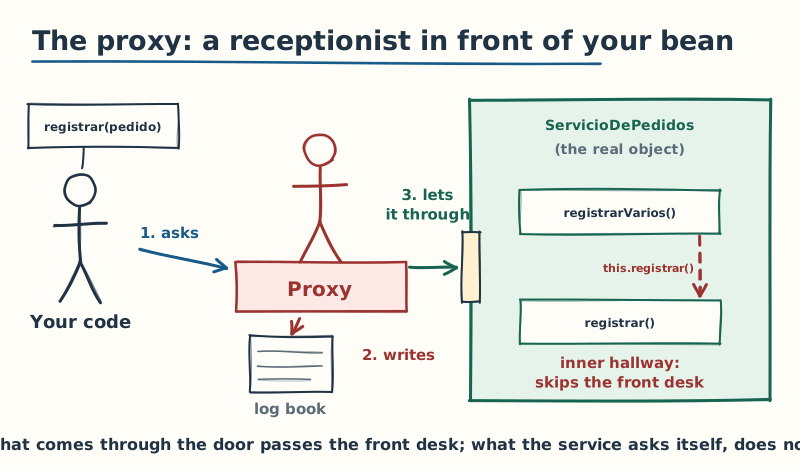
Spring doesn't change your class. It puts another object in front of it:
The proxy is the receptionist: everything that comes in through the door goes past her; what the service asks of itself doesn't.
When an aspect applies to a bean, the container creates a proxy with the same shape, and the proxy is what it hands you (Spring Framework Reference, 7.0). If the class implements interfaces, the proxy is a JDK dynamic proxy for those interfaces; if not, a subclass generated with CGLIB (Spring Framework Reference, 7.0). ServicioDePedidos doesn't implement any:
AopTest.java
@Testvoid elContenedorEntregaUnProxyQuePasaPorElAspecto() { try (var contexto = new AnnotationConfigApplicationContext(ConfiguracionAop.class)) { var servicio = contexto.getBean(ServicioDePedidos.class); var bitacora = contexto.getBean(Bitacora.class); servicio.registrar(new Pedido(42, "ana@example.com")); assertThat(AopUtils.isCglibProxy(servicio)).isTrue(); assertThat(bitacora.entradas()).containsExactly("entra a registrar", "sale de registrar"); }}
The same mechanism powers @Transactional, @Async and other Spring annotations, with the same two traps.
The self-invocation trap
This method records several orders by calling registrar in a loop:
↩ ServicioDePedidos → AspectoDeAuditoriareturnsServicioDePedidos replies to AspectoDeAuditoria: returns
Step 12 of 12
Step 12 of 12: registrarVarios finishes, the aspect logs "sale de registrarVarios" and the response goes back through the proxy. The log has two lines, not six.
What you got from getBean isn't your ServicioDePedidos: it's the proxy the container put in front of it. Your code doesn't notice, because it has the same shape.
The method has @Auditado, so the proxy hands the call to the aspect before touching your object.
The @Around advice does its before part.
proceed() continues to the real object, which saves the order. It's the only moment the aspect lets the call through.
The method finishes and control goes back to the aspect.
The finally block logs the exit and the response goes back through the proxy to your code. Two lines are left in the log.
Now you call registrarVarios. It has @Auditado too, and it comes in through the proxy.
The aspect logs "entra a registrarVarios" and continues with proceed().
The call reaches the real object.
Here's the trap. Inside the object, this is the real object, not the proxy. The call never leaves the object: nobody intercepts it and the aspect never finds out.
Same with the second order. Both get saved, but neither shows up in the log.
registrarVarios finishes, the aspect logs "sale de registrarVarios" and the response goes back through the proxy. The log has two lines, not six.
AopTest.java
@Testvoid laAutoinvocacionNoPasaPorElProxy() { try (var contexto = new AnnotationConfigApplicationContext(ConfiguracionAop.class)) { var servicio = contexto.getBean(ServicioDePedidos.class); var bitacora = contexto.getBean(Bitacora.class); servicio.registrarVarios(List.of(new Pedido(1, "ana@example.com"), new Pedido(2, "luis@example.com"))); assertThat(bitacora.entradas()).containsExactly("entra a registrarVarios", "sale de registrarVarios"); assertThat(servicio.contar()).isEqualTo(2); }}
According to the reference, self-invocation skips the advice, and the best fix is to reorganize the code, for example by moving the inner method to another bean. The alternative is for the bean to inject itself (self injection) and call through that reference, which is the proxy; AopContext.currentProxy() is the last resort, and the reference strongly discourages it (Spring Framework Reference, 7.0).
What a proxy can't intercept
A CGLIB proxy is a subclass, and it can only step in where it can override: public and protected methods (and package-private ones, if needed). A JDK proxy, only the interface's public methods. final and private methods can't be intercepted (Spring Framework Reference, 7.0).
A final method is worse than it looks, and Spring warns you about it at startup:
WARNING: Public final method [public final int com.ejemplo.pedidos.aop.ServicioDePedidos.contarSinAspecto()]cannot get proxied via CGLIB, consider removing the final marker or using interface-based JDK proxies.
ServicioDePedidos.java
@Auditadopublic final int contarSinAspecto() { return repositorio.todos().size();}
Since the subclass can't override it, the call never reaches the real object: it runs on the proxy itself, which never went through your constructor and has empty fields. I checked it with a test, and the result isn't a method that skips the log: it's a NullPointerException, because repositorio is null inside the proxy.
AopTest.java
@Testvoid unMetodoFinalCorreSobreElProxyVacio() { try (var contexto = new AnnotationConfigApplicationContext(ConfiguracionAop.class)) { var servicio = contexto.getBean(ServicioDePedidos.class); assertThatThrownBy(servicio::contarSinAspecto).isInstanceOf(NullPointerException.class); assertThat(contexto.getBean(Bitacora.class).entradas()).isEmpty(); }}
What to take with you: what the container hands you is the proxy, and only what comes in through the proxy gets intercepted: calls through this don't, and neither do final or private methods. Signatures that need to go through a proxy should be public.
Going deeper
the Framework suggests interface-based proxies, and Spring Boot uses class-based proxies by default (spring.aop.proxy-target-class=true). Since 7.0, @Proxyable(INTERFACES) or @Proxyable(TARGET_CLASS) pins the type for a single bean (Spring Framework Reference, 7.0). All of this is Spring AOP, which is proxy-based; if you need more, Spring can use the AspectJ compiler or weaver, which modify the classes themselves (Spring Framework Reference, 7.0). This series doesn't use them.
Transactions
What a transaction is
Buying means saving the order and charging for it. What happens if the order is saved and the charge fails?
Before
ComprasSinTransaccion.java
public void comprar(Pedido pedido, int monto) { repositorio.guardar(pedido); pagos.cobrar(pedido.numero(), monto);}
After
Compras.java
@Transactionalpublic void comprar(Pedido pedido, int monto) { repositorio.guardar(pedido); pagos.cobrar(pedido.numero(), monto);}
Without a transaction, the database ends up with an order nobody paid for. A transaction groups several operations so that either all of them apply or none do: if everything goes well, it's committed; if something fails, it's rolled back and the database goes back to how it was. In both tests, Pagos (payments) rejects a payment with an amount of 0:
@Transactional works with a proxy in front of Compras: before entering the method it opens a transaction; if the method finishes normally, it commits it; if an exception comes out, it rolls it back. It needs two pieces:
ConfiguracionTransacciones.java
@Configuration@EnableTransactionManagement@Import(ConfiguracionDatos.class)public class ConfiguracionTransacciones { @Bean PlatformTransactionManager transactionManager(DataSource dataSource) { return new DataSourceTransactionManager(dataSource); }}
@EnableTransactionManagement turns on the proxies, and the DataSourceTransactionManager knows how to open, commit and roll back a transaction on that DataSource. When it opens one, it binds a connection to the current thread, and JdbcTemplate uses that connection instead of asking for another (Spring Framework API, DataSourceTransactionManager). That's why the repository and Pagos join the same transaction and roll back together.
The annotation goes on comprar (buy), in the service, not in the repository: the unit of work is "buy", which touches two tables, and the order repository doesn't know a charge comes next.
With no parameters, @Transactional uses REQUIRED propagation, the database's isolation level, read-write, and rollback on RuntimeException or Error, but not on a checked exception (Spring Framework Reference, 7.0).
Going deeper
the hand-written JDBC from the previous section, which calls dataSource.getConnection(), would not join the transaction: it would ask for a new connection. You have to get it with DataSourceUtils.getConnection(dataSource), as JdbcTemplate does internally (Spring Framework API, DataSourceTransactionManager).
Rollback only on unchecked
SaldoInsuficiente (insufficient balance) is a checked exception. This method saves the order and then throws it:
Compras.java
@Transactionalpublic void comprarACredito(Pedido pedido, int monto) throws SaldoInsuficiente { repositorio.guardar(pedido); if (monto > 100_000) { throw new SaldoInsuficiente(pedido.numero()); } pagos.cobrar(pedido.numero(), monto);}
The exception leaves the method, but the transaction is committed and the order stays saved. For a checked exception to roll back too, you declare it with rollbackFor, which also covers its subclasses (Spring Framework Reference, 7.0). Since 6.2 you can also change the rule for the whole application with @EnableTransactionManagement(rollbackOn = RollbackOn.ALL_EXCEPTIONS), which the javadoc recommends unless you rely on business exceptions that commit on purpose:
Compras.java
@Transactional(rollbackFor = SaldoInsuficiente.class)public void comprarACreditoSinDejarRastro(Pedido pedido, int monto) throws SaldoInsuficiente { repositorio.guardar(pedido); if (monto > 100_000) { throw new SaldoInsuficiente(pedido.numero()); } pagos.cobrar(pedido.numero(), monto);}
When one @Transactional method calls another, propagation decides what happens:
REQUIRED, the default: if there's already a transaction, it joins it; if not, it opens one. Everyone who joins shares the same physical transaction (Spring Framework Reference, 7.0).
REQUIRES_NEW: it always opens a new, independent transaction, with its own connection, which commits or rolls back on its own.
REQUIRES_NEW is for whatever has to stay written even if the main operation fails, like auditing:
@Transactionalpublic void comprarConAuditoria(Pedido pedido, int monto) { auditoria.registrar("intento de compra del pedido " + pedido.numero()); repositorio.guardar(pedido); pagos.cobrar(pedido.numero(), monto);}
The payment fails, the order is rolled back and the audit line stays:
TransaccionesTest.java
@Testvoid laAuditoriaEnSuPropiaTransaccionSobreviveAlRollback() { var compras = contexto.getBean(Compras.class); assertThatThrownBy(() -> compras.comprarConAuditoria(PEDIDO, 0)).isInstanceOf(PagoRechazado.class); assertThat(filas("pedidos")).isZero(); assertThat(jdbc.queryForList("select mensaje from auditoria", String.class)) .containsExactly("intento de compra del pedido 42");}
Watch out: while the inner transaction runs, the outer one stays open with its connection. With many threads doing this at once, the connection pool can run dry and the threads end up waiting on each other. The reference says not to use REQUIRES_NEW unless the pool has at least one more connection than concurrent threads (Spring Framework Reference, 7.0).
The rollback-only trap
Cupones.aplicar (apply a coupon) is transactional and throws CuponInvalido, an unchecked exception, if the coupon doesn't exist:
Cupones.java
public class Cupones { @Transactional public int aplicar(String codigo) { if (!codigo.equals("BIENVENIDA")) { throw new CuponInvalido(codigo); } return 10; }}
The purchase catches that exception so it can carry on without a discount:
Compras.java
@Transactionalpublic void comprarConCupon(Pedido pedido, int monto, String cupon) { repositorio.guardar(pedido); int descuento = 0; try { descuento = cupones.aplicar(cupon); } catch (CuponInvalido e) { // sin cupón, la compra sigue a precio completo } pagos.cobrar(pedido.numero(), monto - monto * descuento / 100);}
It looks reasonable, but the purchase isn't saved and your code gets an UnexpectedRollbackException:
A caught exception that still rolls back the purchase
↩ Compras proxy → Your codeUnexpectedRollbackExceptionCompras proxy replies to Your code: UnexpectedRollbackException
Step 14 of 14
Step 14 of 14: And it tells you with an exception, so you never believe something was committed when it was rolled back.
The call comes in through the Compras proxy, because the method is @Transactional.
There's no transaction in progress: the proxy opens one and binds its connection to the thread. Every JdbcTemplate on this DataSource running on this thread will use it.
Only now does the call reach your object.
The order is inserted, inside the transaction. It isn't final yet.
Cupones is another bean, so the call goes through its proxy. aplicar is also @Transactional with REQUIRED: since there's already a transaction, it joins it. It doesn't open another one.
The real object checks the coupon.
The coupon doesn't exist: an unchecked exception comes out.
The Cupones proxy sees a RuntimeException leave a transactional method. It can't roll back the transaction, because it didn't open it, so it marks it: this transaction can only end in a rollback.
The exception keeps going up to Compras.
Compras catches it and carries on as if nothing happened. But the mark is already set, and catching the exception doesn't clear it.
The charge is inserted at full price.
The method finishes normally. The Compras proxy, which opened the transaction, is about to commit it.
When it commits, it finds the rollback-only mark. It can't commit: it rolls everything back, the order and the payment.
And it tells you with an exception, so you never believe something was committed when it was rolled back.
The reference describes it like this: with REQUIRED, a rollback-only mark set on the inside affects the outer transaction, and the exception exists so the caller doesn't believe there was a commit (Spring Framework Reference, 7.0).
If an invalid coupon is an expected outcome and not a reason to roll back the purchase, tell Spring with noRollbackFor. With that change, the purchase is saved at full price, and I checked it with a test:
CuponesTolerantes.java
@Override@Transactional(noRollbackFor = CuponInvalido.class)public int aplicar(String codigo) { return super.aplicar(codigo);}
The other way out is for coupon validation not to be transactional: with no proxy, nobody marks anything.
Isolation and readOnly
Two transactions running at the same time can see each other's changes to different degrees. Isolation says how much. Isolation.DEFAULT uses your database's level; the other levels are JDBC's (Spring Framework API, Isolation):
Level
Dirty read
Non-repeatable read
Phantom read
READ_UNCOMMITTED
can happen
can happen
can happen
READ_COMMITTED
prevented
can happen
can happen
REPEATABLE_READ
prevented
prevented
can happen
SERIALIZABLE
prevented
prevented
prevented
A dirty read is seeing a change another transaction hasn't committed; a non-repeatable read, reading the same row twice and getting different values; a phantom read, repeating a query and finding new rows. The stricter the level, the fewer anomalies and the more locking.
readOnly = true declares that the transaction only reads, so the system can optimize. It's a hint, not a prohibition: it doesn't necessarily make a write fail, and a transaction manager that doesn't understand it ignores it silently (Spring Framework API, @Transactional).
@PostConstruct runs without a transaction
This bean loads data at startup, from its @PostConstruct, by calling a @Transactional method that returns whether a transaction is active:
CatalogoInicial.java
public class CatalogoInicial { private boolean huboTransaccionAlArrancar; @PostConstruct void alArrancar() { huboTransaccionAlArrancar = cargar(); } @Transactional public boolean cargar() { return TransactionSynchronizationManager.isActualTransactionActive(); } public boolean huboTransaccionAlArrancar() { return huboTransaccionAlArrancar; }}
At startup there isn't one; called later, through the bean, there is:
TransaccionesTest.java
@Testvoid elPostConstructCorreSinTransaccion() { var catalogo = contexto.getBean(CatalogoInicial.class); assertThat(catalogo.huboTransaccionAlArrancar()).isFalse(); assertThat(catalogo.cargar()).isTrue();}
@PostConstruct runs on the real object, before the proxy arrives (Spring Framework Reference, 7.0), and cargar() (load) is a self-invocation on top of that. The reference warns about it: don't rely on @Transactional inside a @PostConstruct (Spring Framework Reference, 7.0).
What to take with you:@Transactional lives in a proxy, so its rules apply: no self-invocation and no @PostConstruct. And by default it commits on checked exceptions, unless you use rollbackFor or rollbackOn = ALL_EXCEPTIONS.
Events: notify without knowing who
When an order is recorded you have to notify the customer, reserve the stock and, maybe tomorrow, add loyalty points. If every interested party is a dependency of the service, PedidoService grows with every new requirement and you have to edit it each time:
Before
PedidoServiceQueAvisaATodos.java
public class PedidoServiceQueAvisaATodos { private final RepositorioPedidos repositorio; private final Notificador notificador; private final Inventario inventario; public PedidoServiceQueAvisaATodos(RepositorioPedidos repositorio, Notificador notificador, Inventario inventario) { this.repositorio = repositorio; this.notificador = notificador; this.inventario = inventario; } public void registrar(Pedido pedido) { repositorio.guardar(pedido); notificador.enviar(pedido.correoCliente(), "Recibimos tu pedido " + pedido.numero()); inventario.reservar(pedido.numero()); }}
After
PedidoServiceConEventos.java
public class PedidoServiceConEventos { private final RepositorioPedidos repositorio; private final ApplicationEventPublisher eventos; public PedidoServiceConEventos(RepositorioPedidos repositorio, ApplicationEventPublisher eventos) { this.repositorio = repositorio; this.eventos = eventos; } public void registrar(Pedido pedido) { repositorio.guardar(pedido); eventos.publishEvent(new PedidoRegistrado(pedido)); }}
On the right, the service only announces what happened: it publishes an event, which can be any object. Since Spring 4.2 you don't need to extend ApplicationEvent (Spring Framework Reference, 7.0), so a record is enough:
PedidoRegistrado.java
public record PedidoRegistrado(Pedido pedido) {}
Each interested party listens with @EventListener (Spring Framework Reference, 7.0):
AvisoAlCliente.java
public class AvisoAlCliente { private final Notificador notificador; public AvisoAlCliente(Notificador notificador) { this.notificador = notificador; } @EventListener public void alRegistrarse(PedidoRegistrado evento) { var pedido = evento.pedido(); notificador.enviar(pedido.correoCliente(), "Recibimos tu pedido " + pedido.numero()); }}
The container injects the ApplicationEventPublisher and, at startup, looks for its beans' @EventListener methods.
EventosTest.java
@Configurationstatic class ConfiguracionEventos { @Bean RepositorioPedidos repositorioPedidos() { return new RepositorioEnMemoria(); } @Bean PedidoServiceConEventos pedidoService(RepositorioPedidos repositorio, ApplicationEventPublisher eventos) { return new PedidoServiceConEventos(repositorio, eventos); } @Bean NotificadorFalso notificador() { return new NotificadorFalso(); } @Bean AvisoAlCliente avisoAlCliente(Notificador notificador) { return new AvisoAlCliente(notificador); } @Bean Inventario inventario() { return new Inventario(); } @Bean ReservaDeStock reservaDeStock(Inventario inventario) { return new ReservaDeStock(inventario); }}
Adding an interested party means adding a bean with its @EventListener, without touching the service.
By default, listeners run synchronously: publishEvent doesn't return until all of them finish, on the same thread and inside the publisher's transaction (Spring Framework Reference, 7.0); I checked the thread part with a test. With @Async (and @EnableAsync in the configuration) the listener runs separately, but if it fails, the exception never reaches whoever published.
The usual mistake: having the listener send the email inside the publisher's transaction. If the transaction later rolls back, the order doesn't exist, but the email already went out. To notify only if the transaction committed there's @TransactionalEventListener, in Part 3.
The ecosystem map
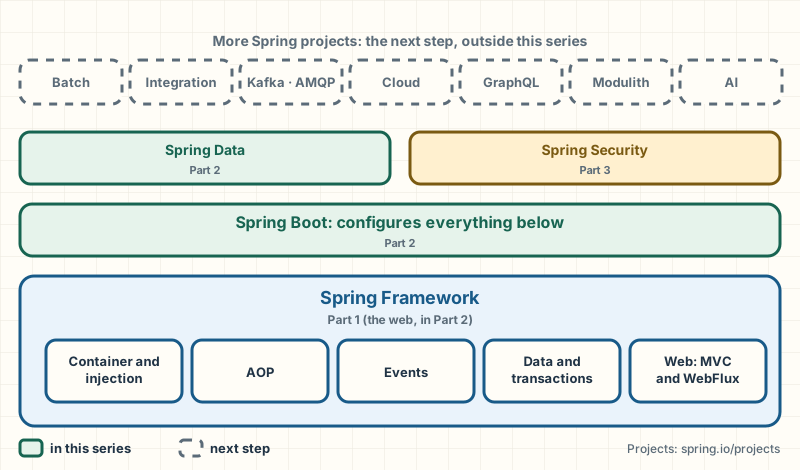
Everything in this part is Spring Framework. The rest is built on that foundation:
A single container at the base; Boot configures it; each project solves one problem on top.
Spring Framework also includes the web: Spring MVC, on top of the Servlet API, and since 5.0 Spring WebFlux, which is reactive (Spring Framework 5.0 goes GA).
Spring Boot configures all of the above with sensible defaults. That's Part 2.
Spring Data gives you a single data access model for relational and non-relational databases; Spring Security, authentication and authorization. They show up in Parts 2 and 3.
The rest is left as a next step, and all of it rests on what you learned here: Spring Batch (batch processing), Spring Integration (integration patterns), Spring for Apache Kafka and Spring AMQP (messaging), Spring Cloud (distributed systems), Spring for GraphQL, Spring Modulith (domain modules) and Spring AI (AI models) (spring.io, Projects).
What only experience teaches
These traps are usually learned through an incident:
State in a singleton. A field that holds something from one customer is shared by every request.
Circular dependencies. Through the constructor, the container won't start, and that's fine: the cycle is a design problem. Through fields, in Spring without Boot, it starts and hides it.
Long constructors. If a constructor asks for seven dependencies, the class does too much. The Spring reference calls it a code smell (Spring Framework Reference, 7.0).
A prototype inside a singleton is injected only once: ObjectProvider.
A typo in @Value arrives as text: a strict resolver or default values.
Rollback with a checked exception: there isn't one, unless you use rollbackFor or rollbackOn = ALL_EXCEPTIONS for the whole application.
Catching the exception from a transactional method doesn't save the transaction if it joined yours.
Self-invocation and final methods skip the proxy, and with it the transaction or the aspect.
If you take away just one idea, make it this one: what the container hands you isn't always your object. Sometimes it's a proxy, and almost every Spring surprise comes from there.
Which of these traps took you the longest to find the first time? And if none of them has bitten you yet, which one would you bet is hiding in your project today?