Kafka: From the Original Problem to Your First Event
Checkout is working, but the email service takes eight seconds and the sales dashboard is down. You want to acknowledge the order without waiting for both, and tomorrow you may need to rebuild today's sales. Let us work through that problem with one order and a small runnable app.
Apache Kafka is a distributed platform for publishing, retaining, and reading event streams. A producer records a fact; Kafka stores records in ordered sequences called partitions; consumers read them and keep track of progress. Separate groups can move independently and revisit retained history. Your applications decide what the facts mean: notify a customer, build a view, or calculate a metric.
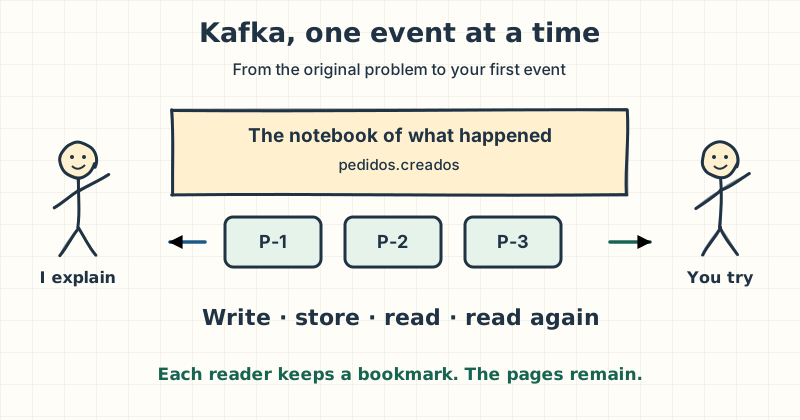
My goal is to help you choose Kafka for a specific reason, follow a record through the system, and operate a small example. We will identify the need, publish a first order early, and then open the mechanism behind that result.
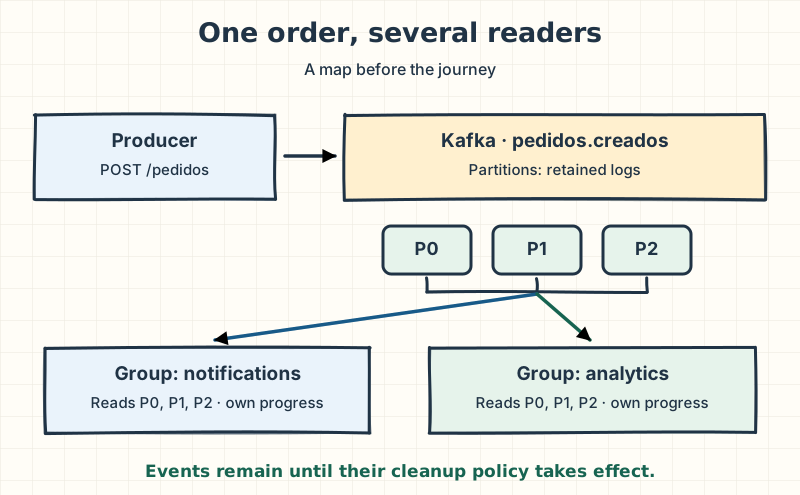
| Your starting point | A route through this same article |
|---|---|
| New to Kafka | Read the problem and origins, run the first event, then work through foundations, parts, and experiments. |
| Already integrating applications | Try the first event, examine the decision criteria, then compare groups, replay, and failures. |
| Designing or operating systems | Start with internals, open the deeper notes, and evaluate ecosystem, contracts, and operations. |
The lab uses Java 21, Spring Boot 4.1.2, and Kafka 4.4.0 KRaft. The complete project
contains its source and tests. Both editions use the same verified code. Spanish names remain
in that shared artifact: PedidoCreado means OrderCreated, pedidoId means order ID, and the
productor and consumidor profiles select producer and consumer roles.
1. the Problem Before Kafka
An Order Method with Too Many Responsibilities
Imagine a createOrder method that saves the order, calls the email service, and updates a sales
dashboard. These actions happen around the same business moment, so putting them together feels
natural. Their responsibilities are different, though. Recording the order belongs to checkout;
sending the email communicates a result; aggregating sales builds a view for another reader.
When you chain them together, checkout inherits their waiting time. It also inherits awkward failure combinations. If analytics returns an error after the order has been saved, what do you tell the customer? Retrying everything might create another order or send another email. Doing nothing could leave the dashboard incomplete. You can encounter this problem with a modest workload; you do not need millions of requests to make the boundaries matter.
A durable work queue may be exactly what you need. Put an email task on it and let a worker finish it later. Kafka is not a prerequisite for asynchronous email. Microservices are not a prerequisite for messaging either: different modules in one application can publish and consume. Start by naming what must survive, which failure it must survive, and how long it must remain recoverable.
A Second Reader Changes the Question
Suppose the notification worker receives an order message and sends the email. A month later, analytics needs the same order facts to calculate hourly sales. It is not competing for the right to send the email. It needs an independent interpretation of the purchase. If you put both workers on the same competing-consumer queue, each receives only part of the work that both actually need.
You can publish copies into two queues. That is a valid publish/subscribe design. The next question is what happens when a third reader arrives later and needs purchases from before it existed. Is there a historical copy? How long does it last? Can the new reader scan it without moving the existing reader's progress? Those questions need explicit answers in the architecture. A broker's product name is not an answer by itself.
This is where a retained sequence of facts, with an independent reading position for each group, becomes interesting. A producer appends to that sequence. Different readers work through it at different speeds. Reading a page does not tear the page out of the notebook. Separating retained data from reading progress is the central idea I want you to keep as the terminology gets more specific.
Communication, Buffering, and Usable History
I separate three needs. Communication means making a fact available to another component. Buffering gives a reader time to catch up when it is temporarily busy or unavailable. Usable history lets a new or corrected reader revisit records that are still retained. Different systems can offer some or all of these properties. Compare the actual needs instead of adding features to a list with no business context.
Takeaway: identify who needs the fact, what can wait, and what history must remain available. Kafka is one possible implementation of those requirements.
2. Why Kafka Appeared When It Did
Two Paths Needed a Shared Foundation
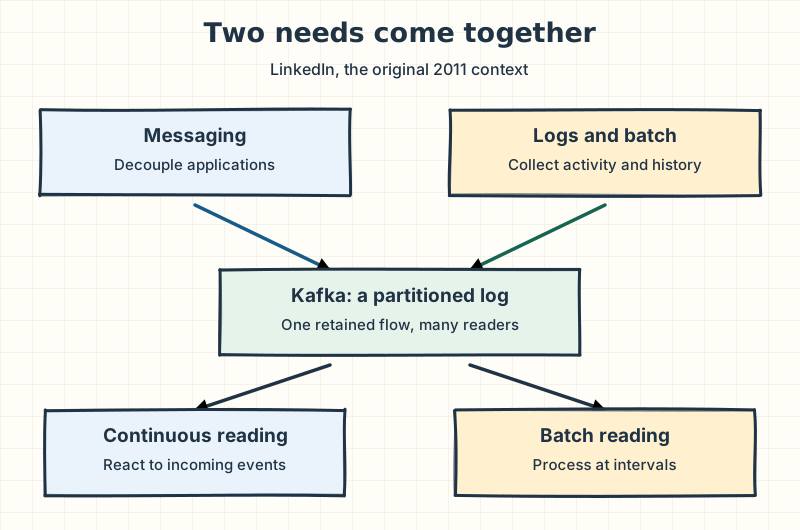
Kafka was built at LinkedIn to move user activity and operational data toward readers with different needs. Some applications reacted continuously; others loaded data for offline analysis. A custom path for every destination multiplied connections, formats, and recovery procedures.
Jay Kreps, Neha Narkhede, and Jun Rao described the design in Kafka: a Distributed Messaging System for Log Processing, presented at NetDB 2011. The original paper compares enterprise messaging and the log aggregators of that period. The requirement was to move a large flow and make it useful to both continuous applications and offline systems.
| Earlier or contemporary approach | What it offered | The need that encouraged another design |
|---|---|---|
| Enterprise messaging; APIs such as JMS and brokers such as ActiveMQ or RabbitMQ | Application communication, delivery, and routing | A suitable combination of throughput, shared history, and independent readers |
| Log aggregators such as Scribe and Flume | Collect activity and move it to data systems | Also serve continuous readers with their own progress |
| Batch processing with Hadoop | Analyze large datasets at intervals | React to that same activity while it continues arriving |
| Database logs | Order changes for recovery and replication | Apply change sequences to integration across systems |
These are different kinds of tools: JMS is an API, while Hadoop is a processing environment. The table compares jobs that needed connecting. It also does not describe every capability in their current releases. For example, RabbitMQ Streams now provides retained logs and non-destructive reading.
The Combination Kafka Chose
Kafka retained records in partitioned logs and let readers traverse them by position. Partitioning distributes work; batching spreads network and write overhead. Separating storage from reading progress makes a new reader possible without adding another direct call to the producer.
| Reference | What it helps explain |
|---|---|
| NetDB, June 2011: paper by Kreps, Narkhede, and Rao | The original problem and design choices |
| LinkedIn, July 2011: Narkhede's public presentation | Activity, logs, and online/offline consumption in practice |
| Kreps, December 2013: The Log | A shared abstraction behind integration, replication, and processing |
| Kafka 4: KRaft replaces ZooKeeper | The metadata coordination used by our current lab |
The LinkedIn presentation and The Log help trace that path. The current documentation explains the move to KRaft.
The shape of the requirement still matters when a purchase feeds notifications, metrics, and new business views. Your scale may be smaller. Evaluate the properties you need and the cost of supporting them. We will first observe the mechanism, then decide how it fits your app.
3. Publish Your First Event
Start with Docker and Compose, Java 21, and three terminal sessions. Maven comes through the
included Wrapper. On Windows, use mvnw.cmd instead of ./mvnw; shell examples assume macOS,
Linux, or a compatible shell.
In the first terminal, get the project and build the executable:
git clone https://github.com/workmanuelherreramesen-lab/manuelherreramesen-profile-site.git
cd manuelherreramesen-profile-site/examples/spring/kafka
java -version
docker compose version
docker compose up -d --wait
./mvnw -DskipTests package
java -jar target/kafka-pedidos-1.0.0.jar --spring.profiles.active=productor
Wait for Started PedidosApplication. The producer serves localhost:8091 and Kafka uses
localhost:9092; both ports must be available. Use the same lab directory in every terminal.
The first run can take longer while images and dependencies download. If Docker fails, inspect
docker compose logs kafka before continuing.
In the second terminal, start the reader. Its profile selects the consumer component, and the last argument avoids starting another HTTP server:
java -jar target/kafka-pedidos-1.0.0.jar \
  --spring.profiles.active=consumidor \
  --spring.main.web-application-type=none
Wait for partition assignment, then publish from the third terminal:
curl -i -X POST http://localhost:8091/pedidos \
  -H 'Content-Type: application/json' \
  -d '{"pedidoId":"pedido-4821"}'
HTTP 202 returns event identity, partition, and offset. The reader logs the matching coordinates. The explained lab includes a complete captured response and a walkthrough of the classes. For now, identify the three boundaries: the request creates an event, the broker acknowledges publication, and the consumer interprets the record.
Try a small change: stop the consumer with Ctrl+C, publish pedido-4822, and restart the same
reader. What do you expect to happen to that second order? Observe your terminal before opening
the explanation.
Solution
the reader finds the pending order because Kafka retained its record and the group can resume progress. Recovery depends on that history remaining available. Later we will set a retention window and inspect the group's position.
You now have a working flow. Leave the processes running for the experiments, or return here when you need them. Keep one HTTP producer instance; launching another on the same port while the first remains active produces a port conflict.
4. When Kafka Is Worth Its Cost
Write the Requirement Before Drawing Topics
Complete this sentence: “These readers need to process these facts, within this delay budget, with this recovery window.” If you cannot identify the readers or the recovery window, you may be selecting a tool too early. You do not need a large architecture document to begin. One purchase, two purposes, and a reconstruction requirement already give you meaningful criteria.
For the store, assume notifications should react promptly, analytics can run a few minutes behind, and analytics must be able to recalculate the last twenty-four hours after a bug fix. That is a reasonable case for investigating Kafka. It does not prove that Kafka is the cheapest choice. It explains which properties a comparison needs to preserve.
If all you need is one email job per purchase, a work queue may be more direct. If checkout must confirm a balance before accepting an order, a synchronous interaction or a local transaction may remain essential. Publishing an event later does not eliminate that decision. Asynchronous communication becomes useful when you can define what is pending and what the customer will see while it remains pending.
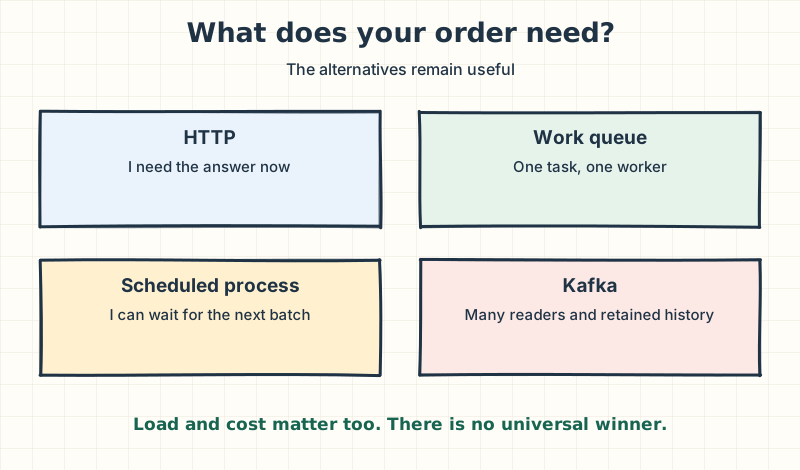
| Dominant requirement | First option I would evaluate | What I would check |
|---|---|---|
| Get an immediate decision from another system | HTTP/RPC | Latency, timeout, availability, and retry idempotency |
| Distribute tasks among workers | A work queue | Acknowledgements, retries, routing, and failure handling |
| Consolidate data at intervals | A scheduled process | Batch window, source load, and recovery |
| Keep a stream for independent readers and replay | Kafka or another distributed log | Retention, partitions, contracts, and operational ownership |
What You Gain When the Model Fits
Independent progress means that one reader can lag behind another while the records remain available. Producers do not need to add another direct call every time a new consumer appears. Retained records provide a basis for recomputation after a logic fix. Partitions give you units of parallel work that can be distributed across the members of a group.
What the Team Must Pay for
The first cost is conceptual. A successful send is not completed business work. A connected consumer is not necessarily caught up. A read record is not necessarily a committed effect. You will design around partial progress, recovery, and contracts that coexist across releases. If the team cannot observe those states, “we published it” can conceal more than it explains.
The second cost is operational: storage, transfer, capacity, upgrades, permissions, and incident response. Managed infrastructure can remove some server administration, but it does not choose your partition key or make an email operation idempotent. There is also an organizational cost: someone owns the event's meaning, approves changes, and responds when an important reader stops.
Signs That a Simpler Option May Be Better
For a small CRUD application with one integration and no reconstruction requirement, I would start with the simpler design. A nightly job may only require a carefully designed incremental query. A customer interaction requiring an immediate decision needs that response boundary first. And if nobody can own the stream's operation, a running container does not prove that you have a supportable system.
Takeaway: justify Kafka through the properties of the flow and its recovery. Your explanation should still make sense before you mention the product name.
5. Foundations You Need, without Requiring an Architecture
An Event Reports; a Command Asks
“Create the order” asks for an action. The request may be rejected because information is missing or a business rule prevents it. “Order created” reports that something has already happened within a boundary you have defined. A consumer may react to that fact, but it should not quietly reinterpret it as a request still waiting for approval. A past-tense name helps communicate the intent; the agreed contract is what makes it real.
Asynchrony separates moments. The producer can finish publishing before the consumer finishes its job. A customer-facing product needs to represent the distinction: “we received your order” and “your order is ready” are different states. HTTP 202 can communicate acceptance, but an API must define what was accepted. In our example it means the broker acknowledged publication, not that every downstream consequence has completed.
The Network Moves Bytes, Not Live Java Objects
A Java instance does not cross the network as a running object. A serializer turns information into bytes, and another program interprets those bytes using an agreed format. We use JSON inside strings because it is easy to inspect and avoids introducing a schema registry into the first exercise. JSON alone is not an automatic contract: two programs can disagree about the meaning of a field while both parse it successfully.
Keep three identities separate. pedidoId identifies the business entity. eventId identifies
one particular fact, which is useful for tracing and possible deduplication. The Kafka key
influences partition selection in the client we use. We choose the order ID as the key, but the
concepts remain distinct. One order can generate many events, each with its own event ID and
the same partitioning key.
A Log and Its Reading Positions
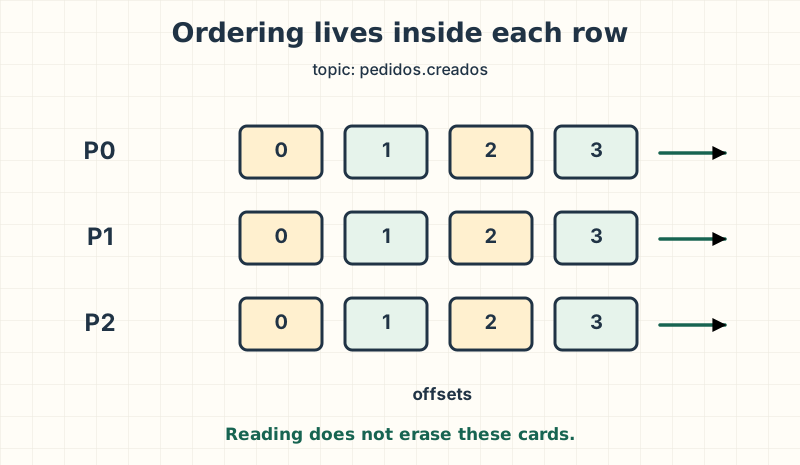
A log is a sequence that receives appended records. Think of numbered pages in a notebook. The numbering lets a reader say where it wants to continue without requiring the writer to know what the reader understood. In Kafka, that sequence exists per partition. There is no single numbering scheme that orders every record in every topic across the cluster.
A sequence of facts is also different from a table of current state. Answering “what is this order's state now?” may require interpreting several events and building a view. That view can live in a database. Choosing a communication mechanism and choosing a query mechanism are connected decisions, but they are not interchangeable.
Concurrency, Partial Failure, and Idempotency
Two readers can move at different speeds, and two producers can publish concurrently. You need to decide which order matters. The business may require the sequence for one purchase while having no need to order every purchase against every other purchase. Finding that boundary lets you introduce useful parallelism without promising an unnecessary global order.
Partial failure means one participant can complete its action while another cannot determine whether it happened. A broker might store an event but lose the acknowledgement on its way back to the producer. A timeout tells the caller that confirmation did not arrive in time. It does not prove that the record is absent. This uncertainty is one reason retries need a business design rather than just another loop.
An idempotent operation tolerates repetition without multiplying its logical effect. Recording an event ID and applying its consequence once is one possible strategy. Sending the same email twice does not become idempotent just because the text is identical. Identity, durable state, and the boundary protecting the effect all matter.
Eventual consistency describes views that take time to reflect a shared fact. The purchase can have been published while the dashboard still shows the previous total. That is not a reason to accept arbitrary delay. Establish an expectation, measure it, and decide what the product should communicate when it is exceeded. An architecture needs a usable delay budget, not merely the word “eventual.”
Knowledge, Execution Requirements, and Design Choices
| To understand the guide | To run the lab | Architectures you may combine with Kafka |
|---|---|---|
| Processes, networks, and data formats | Docker with Compose | A modular monolith or microservices |
| Asynchrony and partial progress | Java 21 and terminal sessions | DDD and hexagonal architecture |
| Sequences, keys, and reading progress | The included Maven Wrapper | CQRS, Event Sourcing, and data platforms |
Kafka needs server processes and compatible clients that can communicate with them. It does not require Spring, Java in every reader, Kubernetes, or a particular cloud provider. The broker image includes its own Java environment; the Java application requires the stated JDK. We chose Spring Boot to connect with the other guides and keep the first lab focused on the flow.
6. the Parts: Open the Order Card
Record, Key, and Value
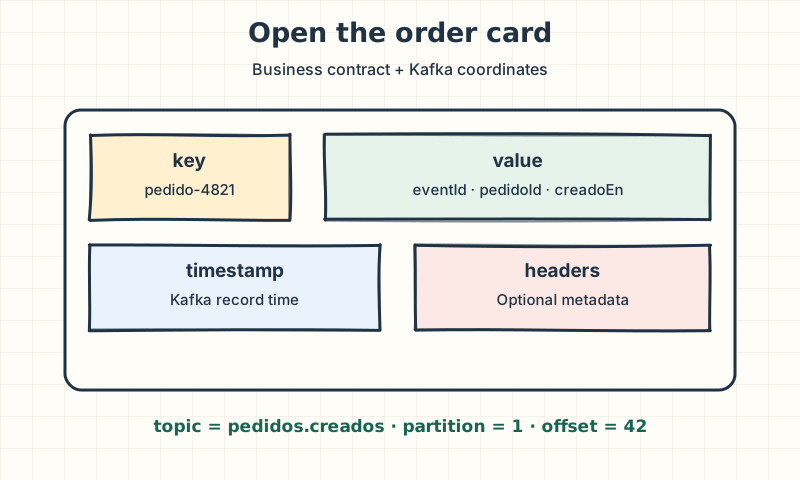
A record is the unit we publish and read. Conceptually it includes a key, value, timestamp,
and optional headers. Our record's value is the JSON representation of PedidoCreado. Its key
is the order identifier. Headers can carry metadata such as correlation information; they are
not a private hiding place for information the reader should not receive. The Apache introduction
establishes this terminology.
The Kafka record timestamp and creadoEn inside our JSON deserve separate names. The second
belongs to the event contract; the first is Kafka metadata whose treatment depends on
configuration. If you later calculate time windows, decide which clock represents the business
fact. Reading something today does not establish that the underlying action happened today.
Topic and Partition
A topic is a named flow, such as pedidos.creados. It is not a separate queue for each
reader. A topic contains partitions, ordered sequences that provide units for distributing
storage and work. Our topic has three. A record belongs to one partition; having three
partitions does not mean the same record is written to all three. Replication is a separate
choice.
A key helps the producer choose a partition. With this client's default partitioning, a
stable non-null key maps to the same partition while the partition count and strategy remain
unchanged. That gives the events for pedido-4821 a useful local sequence. It does not make
uncoordinated producers agree automatically on business order. You must still define the
sequence in which they publish.
Increasing the partition count can increase potential parallelism, but it may also change the mapping from keys to partitions. If your design depends on historical ordering per entity, do not treat that change as transparent. Plan how to migrate, drain, or version the flow. A design that is correct with three partitions should explain what happens when it needs six.
Offset: A Local Coordinate
An offset is a position inside a partition. To locate a record, use topic, partition, and offset together. Offset 42 in partition zero and offset 42 in partition one are different coordinates. Comparing them does not tell you which purchase happened first. They are also not interchangeable with an event's business identity in an external system.
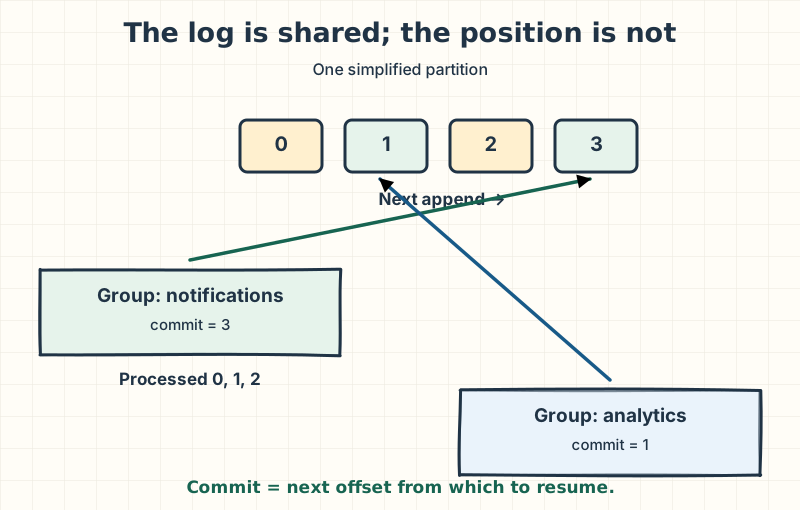
A consumer has a current position as it reads and a committed offset that records where the group should resume. The committed value normally refers to the next record to process: after finishing record 42, progress may be committed as 43. The consumer configuration reference is the place to check offset reset, commits, and client reading behavior.
Producer, Broker, and Controller
The producer is the client that publishes. Our application uses KafkaTemplate as a
convenient integration over the Java client and observes its asynchronous result. A broker
is a server process that serves requests and stores partitions. A cluster is the coordinated
set of processes providing the service. One broker is useful for learning, but it does not
provide a second broker holding another copy of the data.
The controller manages cluster metadata: registered brokers, partitions, leaders, and related changes. KRaft controllers maintain a metadata log through Raft consensus. This does not mean each purchase is committed through a Raft transaction across every broker. Business partition replication has its own mechanism. Separating metadata coordination from business records prevents a surprisingly common misunderstanding.
Our local process combines broker and controller roles for convenience. The KRaft operations guide explains roles and quorum considerations for real operations. A combined-role container is not a template from which to infer the right topology for a critical service.
Consumer and Group
A consumer requests records, interprets them, and does its work. A consumer group coordinates members that divide subscribed partitions. In the model used here, a partition is assigned to one member at a time within a group. Another group can read the same partitions from its own positions without competing with the first group for those records.
With three partitions and two consumers in avisos-demo, one member might receive two
partitions and the other one. The specific assignment depends on the assignor and the group's
state. Adding a fourth member does not create a fourth partition: at least one member will
have no partition from this topic to process. More processes do not remove the parallelism
boundary you chose.
Unassigned
Member A
- P0 (done)
- P1 (done)
- P2 (done)
Member B
Step 4 of 4: B leaves. After reassignment, A resumes all partitions from group commits. The log still retains its records.
- Tokens represent partition assignments, not records removed by reading.
- A joins and can read all three topic partitions in this group.
- B joins. After rebalance, one possible assignment gives A two partitions and B one. Ownership does not overlap within the group.
- B leaves. After reassignment, A resumes all partitions from group commits. The log still retains its records.
Going deeper
in Share Groups, members share work through record acquisition and
acknowledgement, with temporary locks and possible redelivery. More consumers than partitions
can therefore collaborate. Our conventional consumer groups assign each partition to one
member and commit a log position; records may return after a failure. These are different
progress models with their own APIs and configuration. This lab uses KafkaConsumer, not
KafkaShareConsumer. Read Share Consumer in the Kafka 4.4 design
before carrying rules from one model into the other.
7. the Internal Journey: From Send to Commit
1. Discovering Where to Write
An application starts with addresses in bootstrap.servers. They let it discover metadata:
which brokers exist and which broker leads each partition. A producer does not necessarily
send everything to the first bootstrap address and ask that server to route all records. It
uses the metadata to connect to the appropriate destination.
That explains a common Docker failure. The first connection to localhost:9092 succeeds, but
the broker advertises a name that the application cannot resolve. The next connection fails.
listeners describes where a server listens; advertised.listeners describes the addresses
it tells clients to use. The listener configuration guide
documents the distinction. Our setup provides a host address and an internal Docker address.
Three Responsibilities to Keep Separate
| Role | What it coordinates | In the order journey |
|---|---|---|
| KRaft controller | Cluster metadata and leadership changes | Records which broker leads each partition |
| Partition leader | Writes and replication for that log | Receives our Produce request |
| Group coordinator | Membership, assignment, and group offsets | Helps avisos-demo resume reading |
A broker can perform several roles. The group coordinator is the broker responsible for that
group; it need not lead the partition containing our order. KRaft does not hold a vote for every
PedidoCreado: metadata consensus and event replication follow different paths.
2. Serializing, Partitioning, and Batching
The producer serializes the key and value, selects a partition, and can group records into batches. Sending a batch spreads the cost of a network request across many small records. Batch size and the time allowed to form batches influence throughput, memory, and latency. This is one reason a production tuning discussion needs a workload and a delay budget rather than a universally “best” collection of settings.
The producer reference describes acknowledgements, idempotency, timeouts, and batching. Our request has bounded waiting time so it cannot wait indefinitely for the broker. When that time expires, the honest result is uncertainty about confirmation, not proof that no record was written.
3. Receiving and Appending
The broker's network layer accepts requests and passes them to handlers. A Produce request
ultimately appends records to the relevant logs, subject to validation and server conditions.
A Fetch request asks for data starting at particular positions. The network layer
and message format references
describe these interfaces and the batch representation.
A partition log is divided into segments. The active segment receives appends, while older segments provide manageable units for retention and access. Indexes help locate positions without treating the topic as one huge in-memory collection. The log implementation is a useful next read when “Kafka stores messages” is no longer a detailed enough mental model.
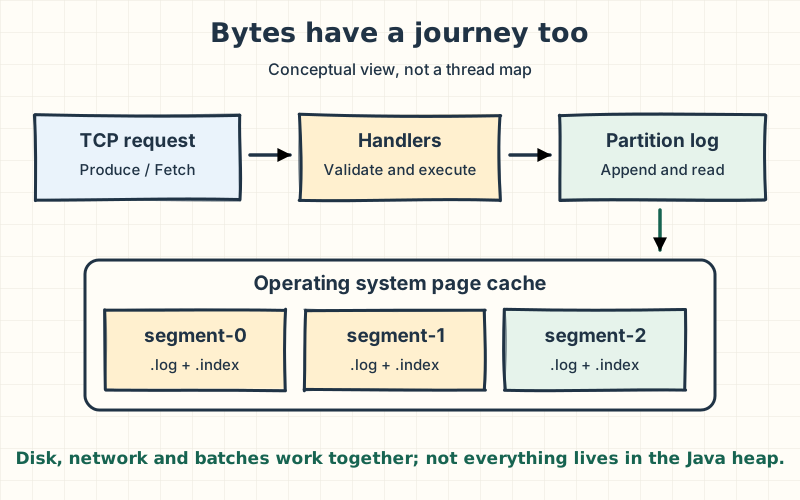
Kafka makes use of the operating system and its page cache. Sequential access, batching, and
efficient transfer paths help move data without keeping a permanent Java object for every
retained event. This does not mean all data lives in memory. It also does not mean every
acknowledgement forces every replica to perform a physical fsync. Replication, persistence,
and physical synchronization are connected but distinct mechanisms.
Going deeper
on compatible paths, zero-copy avoids copying file bytes into an application buffer and back into the kernel: the OS can transfer them from its page cache to the socket. That reduces copying and CPU work while reading. TLS can require another path for encryption; do not assume this optimization applies to every connection. Producers can also compress batches, trading CPU and latency choices for less network traffic and disk usage. Batching, compression, and caching explain part of the performance; a benchmark with a different key distribution does not establish your capacity.
4. Replicating and Acknowledging
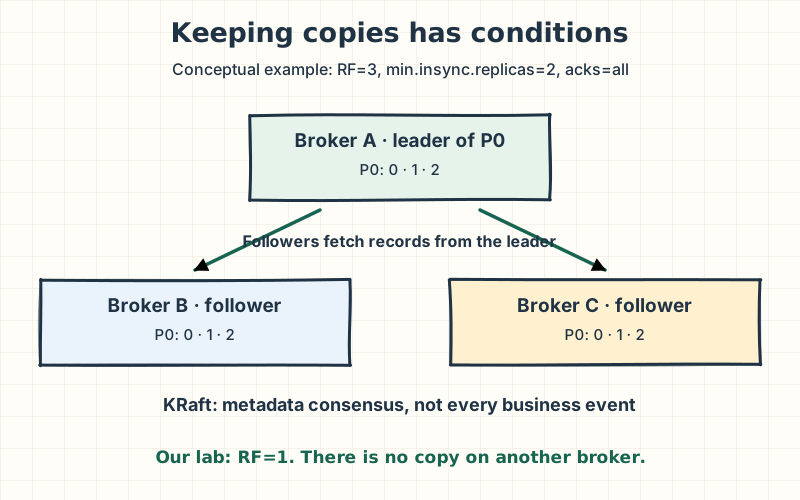
A replicated partition has a leader and follower replicas. The leader accepts writes and followers fetch records to maintain their copies. The ISR is the set of replicas considered in sync; the leader is part of that set. Three partitions are not three replicas. You can have three partitions that exist on only one broker.
With acks=all, the leader waits for acknowledgement from the ISR replicas.
min.insync.replicas sets a minimum condition for accepting the write; it is not a fixed
number of acknowledgements to wait for. For replication factor three and a minimum of two:
| Current ISR | What happens with acks=all? |
|---|---|
| Leader and two followers: 3 | Wait for all three ISR replicas |
| Leader and one follower: 2 | Wait for both; the out-of-sync replica does not by itself block the write |
| Leader alone: 1 | The minimum is not met; the write fails |
The ISR can change during a request, and an error alone does not prove that no bytes were written. This is an acknowledgement policy tied to replication state, rather than protection against every possible loss. The topic configuration reference spells out the conditions.
Our replication factor is one. acks=all therefore acknowledges the one available replica; it
does not create another. A Docker volume can preserve data across container recreation, but
that volume is still on the same machine. Losing that storage leaves no other lab broker with
a copy. We are demonstrating communication and recovery of reading progress, not certifying
infrastructure fault tolerance.
5. Reading Is Not Removing
A consumer requests records through poll. Its client handles connections, fetching, and group
participation. Spring adds a container that runs that activity and invokes our listener method.
@KafkaListener does not make the broker call a Java method inside your process. The consumer
application is actively reading through its client.
Receiving records advances the client's local position. Your code can still fail while parsing
or applying an effect. We therefore need an explicit progress policy. In our configuration,
client auto-commit is disabled and the Spring container uses record acknowledgement mode:
after the listener returns successfully for a record, the container commits the corresponding
progress. The listener-container reference
explains that policy.
Kafka stores group progress through internal mechanisms, including its offsets topic. Committing does not edit or delete the original business record. Another group can still read it while it remains available. Conversely, a slow group's bookmark does not prevent retention from removing old data. Data lifetime and reading progress have separate responsibilities.
Four Positions on One Partition
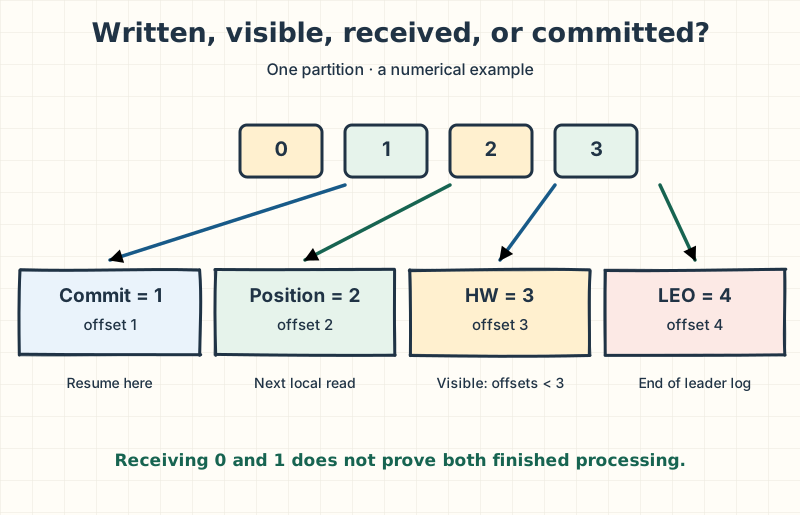
Consider a partition containing offsets 0, 1, 2, 3. These boundaries describe different things:
| Position | Example value | Meaning |
|---|---|---|
| Leader log end offset (LEO) | 4 | Next offset at the end of its log; record 3 is present |
| High watermark (HW) | 3 | Exclusive boundary of replicated data visible to ordinary reads: 0, 1, and 2 |
| Client position | 2 | Next read starts at 2; poll already returned earlier records |
| Group committed offset | 1 | A member resuming that partition starts at 1 |
The consumer could have received 0 and 1, processed only 0, and committed 1. If it stops now, record 1 will be delivered again even though its local position was already 2. Meanwhile, record 3 being present on the leader does not make it readable beyond the HW. A client's position is not proof that your code finished its work.
Going deeper
isolation.level=read_committed adds the last stable offset (LSO).
It is the smaller of the HW and the first offset belonging to an open transaction. Consumers
do not cross that boundary and filter records from aborted transactions. If an open
transaction starts at 1 while HW is 3, LSO is 1: later replicated records may still be
unavailable to that reader. LSO is unrelated to your group's commit. See the definitions in
the consumer API.
- HTTP calls Producer: POST /pedidos
- Producer calls Broker: Produce(key=pedido-4821)
- Broker replies to Producer: partition=2, offset=0
- Producer replies to HTTP: 202 Accepted
- Consumer calls Broker: Fetch
- Broker replies to Consumer: PedidoCreado
- Consumer calls itself: recibir(record)
- Consumer calls Group coordinator: OffsetCommit(next=1)
Step 8 of 8: With ack-mode=record, Spring commits after successful return. The group can resume at the next offset.
- The request creates an event in our application. Kafka has not acknowledged it yet.
- The client sends bytes to the selected partition. This lab has only one replica.
- The broker acknowledges publication. These coordinates illustrate a run; your values can differ.
- The response confirms acknowledged publication. Consumer work may still be pending.
- The consumer requests data. The broker does not directly invoke our Java method.
- The record is read and remains in the log. Reading does not remove the card.
- The listener parses JSON and writes its log line. A failure here is not a failed publication.
- With ack-mode=record, Spring commits after successful return. The group can resume at the next offset.
6. Retention, Compaction, and Recovery
Our topic uses cleanup.policy=delete with a twenty-four-hour retention setting. Removal works
through segments and maintenance activity. Do not interpret the number as a separate timer
that deletes every individual record at exactly its twenty-four-hour birthday. It expresses a
policy, not that level of per-record temporal precision.
Compaction serves a different purpose: retaining the latest value per key, subject to the cleaner's timing and related rules. It can support state reconstruction, but it does not retain every business transition. If older order versions disappear, the history you wanted for audit may be gone. Tombstones, delayed readers, and cleanup windows need deliberate consideration before a compacted topic becomes part of a state design.
Going deeper
imagine a compacted topic with 0: A=pending, 1: B=pending,
2: A=paid, and 3: B=null. Cleaning can remove 0 because 2 retains A's latest value.
The null value at 3 is a tombstone, marking B for deletion; it is not the JSON text
"null". The cleaner can remove B's older value and, after the relevant retention period,
the marker itself. Surviving offsets are not renumbered. Cleaning is asynchronous, so reads
can still encounter several versions. A rebuilding reader must finish before losing the
deletion markers it needs; review delete.retention.ms in the topic configuration.
A replay revisits records that still exist. It cannot recover data removed by retention. It also cannot guarantee the same result when processing depends on external information that has changed. If an old calculation looked up a price that is different today, rerunning the same code may produce a different answer. Decide what information belongs in the event and which other inputs need versioning or preservation.
Takeaway: publication, replicated storage, reading, processing, and committing are separate steps. During a failure, identify which happened and which remains uncertain.
8. the Explained Lab and Its Experiments
If you ran the first event, Kafka, the producer, and a consumer are already running. We will now inspect their configuration and change one variable at a time. If you closed the session, use that earlier walkthrough to restart it.
The Environment You Just Ran
This is the project's version-and-digest-pinned Compose file:
services:
  kafka:
    image: apache/kafka:4.4.0@sha256:833b867a9585a141da455dc2b57431c65cbccb27f11c91f694444cca9f777e0f
    ports:
      - "127.0.0.1:9092:9092"
    environment:
      CLUSTER_ID: "MkU3OEVBNTcwNTJENDM2Qk"
      KAFKA_NODE_ID: 1
      KAFKA_PROCESS_ROLES: broker,controller
      KAFKA_LISTENERS: EXTERNAL://:9092,INTERNAL://:19092,CONTROLLER://:9093
      KAFKA_ADVERTISED_LISTENERS: EXTERNAL://localhost:9092,INTERNAL://kafka:19092
      KAFKA_LISTENER_SECURITY_PROTOCOL_MAP: EXTERNAL:PLAINTEXT,INTERNAL:PLAINTEXT,CONTROLLER:PLAINTEXT
      KAFKA_INTER_BROKER_LISTENER_NAME: INTERNAL
      KAFKA_CONTROLLER_LISTENER_NAMES: CONTROLLER
      KAFKA_CONTROLLER_QUORUM_VOTERS: 1@kafka:9093
      KAFKA_OFFSETS_TOPIC_REPLICATION_FACTOR: 1
      KAFKA_TRANSACTION_STATE_LOG_REPLICATION_FACTOR: 1
      KAFKA_TRANSACTION_STATE_LOG_MIN_ISR: 1
      KAFKA_GROUP_INITIAL_REBALANCE_DELAY_MS: 0
      KAFKA_AUTO_CREATE_TOPICS_ENABLE: "false"
      KAFKA_LOG_DIRS: /var/lib/kafka/data
      KAFKA_LOG_RETENTION_HOURS: 24
      KAFKA_HEAP_OPTS: -Xms128m -Xmx256m
    volumes:
      - kafka-datos:/var/lib/kafka/data
    healthcheck:
      test: ["CMD", "/opt/kafka/bin/kafka-topics.sh", "--bootstrap-server", "kafka:19092", "--list"]
      interval: 5s
      timeout: 10s
      retries: 20
      start_period: 15s
volumes:
  kafka-datos:
EXTERNAL provides the host connection, and INTERNAL lets tools inside the Compose network
use kafka:19092. The controller listener serves the KRaft role. These are names we assign to
listeners, not three separate products. The external port is bound to the local interface.
PLAINTEXT is used because this is a local learning environment.
The volume preserves the log when the container is stopped. Replication settings of one allow internal topics to run on a single broker. Do not carry these settings into a production design without reevaluating the required guarantees. The fixed cluster ID belongs to this lab's storage; changing it over an existing volume is not equivalent to starting a clean new cluster.
Use docker compose ps and the service logs to inspect the environment. The health check
queries Kafka's API, and the volume preserves history across sessions.
Dependencies and Application Entry Point
The project inherits Spring Boot 4.1.2 and targets Java 21. These dependencies provide Kafka integration, HTTP, and validation. Boot manages compatible versions rather than making the example independently pin every transitive library:
<dependency>
    <groupId>org.springframework.boot</groupId>
    <artifactId>spring-boot-starter-kafka</artifactId>
</dependency>
<dependency>
    <groupId>org.springframework.boot</groupId>
    <artifactId>spring-boot-starter-webmvc</artifactId>
</dependency>
<dependency>
    <groupId>org.springframework.boot</groupId>
    <artifactId>spring-boot-starter-validation</artifactId>
</dependency>
The entry point is the familiar Boot application. If you want more background on what Boot configures, the site's Spring Boot guide works through that mechanism separately:
@SpringBootApplication
public class PedidosApplication {
    public static void main(String[] args) {
        SpringApplication.run(PedidosApplication.class, args);
    }
}
We declare a topic through Spring's administrative integration. The full project contains the
imports; the article's synchronized fragments focus on the decisions we are studying.
NewTopic asks for the topic during startup, so the first successful application startup also
establishes the flow used by later terminal commands.
public static final String TOPIC = "pedidos.creados";

@Bean
NewTopic pedidosCreados(@Value("${demo.topic:pedidos.creados}") String topic) {
    return TopicBuilder.name(topic)
            .partitions(3)
            .replicas(1)
            .config("cleanup.policy", "delete")
            .config("retention.ms", "86400000")
            .build();
}
The expression ${demo.topic:pedidos.creados} asks Spring for a configurable name, defaulting
to pedidos.creados. Tests use a different name to keep their records separate from your session.
If a topic already exists with different settings, do not assume restarting this application recreates it exactly as shown. Inspect it with the administrative tools. A fresh lab begins with fresh storage; a repeated session may preserve old records and group offsets. Learning to observe that history is part of the exercise, not a setup defect.
The Event and the Configuration
The event contract is deliberately small: event identity, order identity, and creation time.
A Java record expresses that data without suggesting that consumers should mutate a shared
object. The field names remain the same in both language editions because both use one tested
project.
public record PedidoCreado(UUID eventId, String pedidoId, Instant creadoEn) {}Read the configuration as carefully as the classes:
server:
  port: ${PORT:8091}
spring:
  application:
    name: kafka-pedidos
  kafka:
    bootstrap-servers: ${KAFKA_BOOTSTRAP_SERVERS:localhost:9092}
    admin:
      fail-fast: true
    producer:
      key-serializer: org.apache.kafka.common.serialization.StringSerializer
      value-serializer: org.apache.kafka.common.serialization.StringSerializer
      acks: all
      properties:
        enable.idempotence: true
        max.block.ms: 5000
        request.timeout.ms: 5000
        delivery.timeout.ms: 10000
    consumer:
      group-id: ${KAFKA_GROUP:avisos-demo}
      auto-offset-reset: earliest
      enable-auto-commit: false
      key-deserializer: org.apache.kafka.common.serialization.StringDeserializer
      value-deserializer: org.apache.kafka.common.serialization.StringDeserializer
    listener:
      ack-mode: record
      concurrency: 1
The string serializer turns our JSON string into bytes, and the string deserializer returns a
string for the listener to interpret. acks=all and producer idempotency make the publication
intent explicit. The timeouts bound waiting. enable-auto-commit=false leaves progress control
to the Spring container, whose record acknowledgement mode ties the commit to successful
listener completion.
earliest applies when the group does not have a valid position from which to continue. It
is not an instruction to restart from the beginning on every launch. If avisos-demo has
already committed progress, restarting with the same ID respects that progress. We will test
the difference by changing only the consumer's group name.
The HTTP Producer
The controller accepts a short pedidoId, creates a fresh event, serializes it, and publishes
using the order ID as the key. It waits for the send result before returning partition and
offset. HTTP 202 confirms acknowledged publication. It does not certify that an email has been
sent or a sale counted; neither effect exists in this project.
@RestController
@Profile("productor")
@RequestMapping("/pedidos")
public class PedidoController {
    private final KafkaTemplate<String, String> kafka;
    private final JsonMapper json;
    private final String topic;

    public PedidoController(KafkaTemplate<String, String> kafka, JsonMapper json,
            @Value("${demo.topic:pedidos.creados}") String topic) {
        this.kafka = kafka;
        this.json = json;
        this.topic = topic;
    }

    public record CrearPedido(
            @Pattern(regexp = "[A-Za-z0-9-]{1,40}") String pedidoId) {}
    public record Publicado(UUID eventId, String pedidoId, int particion, long offset) {}

    @PostMapping
    @ResponseStatus(HttpStatus.ACCEPTED)
    public Publicado crear(@Valid @RequestBody CrearPedido entrada) {
        if (entrada.pedidoId() == null) {
            throw new ResponseStatusException(HttpStatus.BAD_REQUEST, "Falta pedidoId");
        }
        var evento = new PedidoCreado(UUID.randomUUID(), entrada.pedidoId(), Instant.now());
        try {
            var resultado = kafka.send(topic, evento.pedidoId(),
                    json.writeValueAsString(evento)).get(12, TimeUnit.SECONDS);
            var metadata = resultado.getRecordMetadata();
            return new Publicado(evento.eventId(), evento.pedidoId(),
                    metadata.partition(), metadata.offset());
        } catch (InterruptedException e) {
            Thread.currentThread().interrupt();
            throw noConfirmado(e);
        } catch (ExecutionException | TimeoutException | org.apache.kafka.common.KafkaException
                | org.springframework.kafka.KafkaException e) {
            throw noConfirmado(e);
        }
    }

    private ResponseStatusException noConfirmado(Exception causa) {
        return new ResponseStatusException(HttpStatus.SERVICE_UNAVAILABLE,
                "Publicación no confirmada; un reintento puede duplicar el evento", causa);
    }
}
If confirmation cannot be obtained, the controller returns 503 while preserving the possibility that retrying could duplicate the event. The blocking wait is intentional in this small lab: it exposes the acknowledgement boundary without introducing another asynchronous HTTP flow. A high-load API might handle concurrency differently, but it would still need to observe the publication outcome.
Each request generates a new eventId. Repeating a POST is therefore not business-idempotent.
Kafka producer idempotency protects certain protocol retries; it does not recognize that two
separate HTTP requests represent the same purchase. This limitation belongs beside the code,
where you can see it before replacing a teaching signal with real business work.
An HTTP Error That Explains Uncertainty
The controller throws an exception with context, but its warning must survive conversion to
an HTTP response. This advice applies only to the order controller and returns ProblemDetail,
the error format supported by Spring MVC,
with a status, detail, and request path. It exposes neither stack traces nor internal exceptions.
@RestControllerAdvice(assignableTypes = PedidoController.class)
public class ErroresHttp {
    @ExceptionHandler(ResponseStatusException.class)
    public ProblemDetail responder(ResponseStatusException error) {
        var problema = ProblemDetail.forStatusAndDetail(error.getStatusCode(),
                error.getReason() == null ? "Solicitud no completada" : error.getReason());
        problema.setTitle(error.getStatusCode().value() == 503
                ? "Publicación no confirmada" : "Solicitud rechazada");
        return problema;
    }
}
The HTTP test verifies application/problem+json, status 503, and the warning
“un reintento puede duplicar” in detail. You can also observe it by stopping the broker,
requesting an order, and starting Kafka again. The producer's waits remain bounded.
Stopping the broker produced this HTTP response. The warning is present in the response body, rather than only in the server log:
{
  "detail": "Publicación no confirmada; un reintento puede duplicar el evento",
  "instance": "/pedidos",
  "status": 503,
  "title": "Publicación no confirmada"
}
The Consumer
The listener accepts the full record so that its coordinates are observable. It parses the JSON and writes one log line. The group comes from configuration. Running this exact code with a different group changes which reading progress it shares, making it a convenient way to isolate the group concept without adding another business service.
@Component
@Profile("consumidor")
public class ConsumidorPedidos {
    private static final Logger log = LoggerFactory.getLogger(ConsumidorPedidos.class);
    private final JsonMapper json;

    public ConsumidorPedidos(JsonMapper json) {
        this.json = json;
    }

    @KafkaListener(id = "lector-pedidos", topics = "${demo.topic:pedidos.creados}",
            groupId = "${spring.kafka.consumer.group-id}")
    public void recibir(ConsumerRecord<String, String> record) {
        PedidoCreado evento;
        try {
            evento = json.readValue(record.value(), PedidoCreado.class);
        } catch (JacksonException error) {
            log.error("PEDIDO_INVALIDO topic={} key={} partition={} offset={}",
                    record.topic(), record.key(), record.partition(), record.offset());
            throw error;
        }
        log.info("PEDIDO eventId={} pedidoId={} key={} partition={} offset={}",
                evento.eventId(), evento.pedidoId(), record.key(),
                record.partition(), record.offset());
    }
}
A processing error stops the listener container in this lab. That makes an unprocessable JSON record visible instead of quietly treating it as completed after some retry limit. It is a deliberate teaching policy, not a universal production recommendation:
@Bean
CommonContainerStoppingErrorHandler detenerAnteError() {
    return new CommonContainerStoppingErrorHandler();
}
The application process may remain alive after its listener stops. Fixing the cause and restarting the reader is required before it can continue; the pending record will be encountered again. Later we will discuss bounded retries and error topics. Neither should be added without deciding what skipping or delaying the event means to the business.
Working Through the Six Experiments
Write a one-sentence prediction before changing anything. Run the instruction, compare the result, and then open the explanation. Your IDs and offsets may differ; the relationships between them are the point of the exercise.
Experiment 1: Publish and Locate the Record
Predict: can a producer publish before any consumer is ready? What exactly does HTTP 202 acknowledge?
Try: publish another order and compare its coordinates with the reader terminal.
curl -i -X POST http://localhost:8091/pedidos \
  -H 'Content-Type: application/json' \
  -d '{"pedidoId":"pedido-4821"}'
Observe: HTTP 202 returns eventId, pedidoId, particion, and offset. The consumer prints
a line beginning with PEDIDO, including the matching identity and storage coordinates. Do not
compare your result with a hard-coded partition from someone else's run. Match the result of
your own request with the corresponding record observed by the listener.
This capture comes from the verified run on November 6, 2026, with the log trimmed to its message. Your IDs and coordinates may differ:
{
  "eventId": "b1f5c34a-e4a1-407a-b0ba-49c02e40cd94",
  "pedidoId": "pedido-4821",
  "particion": 2,
  "offset": 0
}PEDIDO eventId=b1f5c34a-e4a1-407a-b0ba-49c02e40cd94 pedidoId=pedido-4821 key=pedido-4821 partition=2 offset=0The subsequent group query reported CURRENT-OFFSET=1, LOG-END-OFFSET=1, and LAG=0
for partition 2. The event was at 0; the commit stores 1, the next position.
Solution
yes, provided Kafka is available and accepts the write. HTTP 202 acknowledges publication, not processing. Producer and consumer meet through the log. The automated test additionally checks that the group's committed offset advances beyond the processed record. Seeing the log line and seeing committed progress are observations of different stages, which is why both are useful.
Experiment 2: Stop the Reader
Predict: what changes when only the reader stops? Who will recover the order published during its absence?
Try: press Ctrl+C in the consumer terminal. Leave Kafka and the producer running.
Publish pedido-4822 using the earlier request with a different ID, then restart the consumer.
Observe: the pending order is processed when the group resumes. You may see other pending records if you made additional requests. The producer does not need to track the reader's availability or manually resend the event when it comes back.
Solution
retained records and committed progress make recovery possible. The experiment does not cover a reader that remains down beyond the retention window. If the data has been removed, you need another source of recovery or a business decision that accepts that history is no longer available.
Experiment 3: Share Partitions Between Two Consumers
Predict: with two members and three partitions, does each member receive every order or do they divide the work?
Try: keep the first consumer running and start the same command in another terminal. Wait for the rebalance, then inspect membership:
docker compose exec kafka /opt/kafka/bin/kafka-consumer-groups.sh \
  --bootstrap-server kafka:19092 --describe --group avisos-demo --members --verbose
Observe: both members have assignments, with no overlapping ownership within the group. Publish several orders with different keys. One key should not spread across all three partitions. Also, three arbitrarily chosen keys do not necessarily hash into three different partitions, so do not use that assumption to judge the result.
Solution
ownership is divided by partition. A record is processed by the member responsible for its partition while another member can work elsewhere. The automated test publishes to known partitions to verify sharing without depending on accidental hash distribution among our example order IDs.
Experiment 4: Add an Independent Purpose
Predict: does a consumer in analitica-demo compete with members of avisos-demo?
Can it read an order that notifications already committed?
Try: start another reader:
java -jar target/kafka-pedidos-1.0.0.jar \
  --spring.profiles.active=consumidor \
  --spring.main.web-application-type=none \
  --spring.kafka.consumer.group-id=analitica-demo
Observe: if this group is new, earliest lets it read retained history from the beginning.
Publish another order. The notification group and analytics group can both process it. Members
inside the notification group still divide their own work among themselves.
Solution
we did not duplicate the topic for each purpose, and committing did not erase the records. We created independent progress and interpretation. A real analytics application would execute different code; using the same listener here keeps the experiment focused on one changed variable.
Experiment 5: Replay Retained Records
Predict: does restarting analitica-demo replay the same history as starting a new
group? Which position takes priority when a commit already exists?
Try: first restart analitica-demo, then choose a fresh, recognizable group:
java -jar target/kafka-pedidos-1.0.0.jar \
  --spring.profiles.active=consumidor \
  --spring.main.web-application-type=none \
  --spring.kafka.consumer.group-id=replay-estudio-01
Observe: the new group traverses records that are still retained. If you already used that
name, choose another, such as replay-estudio-02. The tests explicitly distinguish resuming a
group with committed offsets from starting a new group with earliest.
Solution
replay means another reading, not permission to repeat external consequences without control. Rebuilding analytics into a new view is one useful approach. Replaying emails, payments, or remote mutations requires an effect-protection strategy and a reconstruction mode that understands which actions should not happen again.
- avisos-demo calls Retained log: 0, 1, 2: Fetch(0)
- Retained log: 0, 1, 2 replies to avisos-demo: 0, 1, 2
- replay-estudio-01 calls Retained log: 0, 1, 2: earliest → Fetch(0)
- Retained log: 0, 1, 2 replies to replay-estudio-01: 0, 1, 2
- avisos-demo calls Retained log: 0, 1, 2: Fetch(3)
Step 5 of 5: On return, notifications continues at 3. earliest does not reset valid group progress. Neither reader recovers records already removed by retention.
- Notifications starts at 0 and processes the three available records.
- The cards remain. This group commits its next position: 3.
- The replay group is new and has no commits; earliest selects the available beginning.
- The second reader sees the same history. It does not move notification commits.
- On return, notifications continues at 3. earliest does not reset valid group progress. Neither reader recovers records already removed by retention.
Experiment 6: Keep the Key Stable
Predict: when you repeat a key, what happens to the partition, offsets, and eventId?
Try: repeat the POST with pedido-4821 three times, waiting for each response before
sending the next. Compare the responses with their corresponding consumer log lines.
Observe: the partition remains the same and offsets increase. Other keys may have records interleaved between them. That does not violate this order's local sequence. If you submit requests concurrently, do not treat click order or HTTP response order as a business sequence your producer never explicitly established.
Solution
the experiment concerns one producer, a stable key, and a fixed partition count. Consumer behavior matters too. A reader can receive records in order but launch their effects into concurrent tasks that finish out of order. Storage order and effect-completion order need separate answers.
Inspect, Test, and Close the Lab
Inspect the topic and the group's progress with the included tools:
docker compose exec kafka /opt/kafka/bin/kafka-topics.sh \
  --bootstrap-server kafka:19092 --describe --topic pedidos.creados

docker compose exec kafka /opt/kafka/bin/kafka-consumer-groups.sh \
  --bootstrap-server kafka:19092 --describe --group avisos-demo
CURRENT-OFFSET shows committed progress, while LOG-END-OFFSET shows the end position reported
by the tool. The difference helps you reason about backlog, with the broader model's caveats
about transactions and internal records. It is not a duration in seconds. Two thousand records
could represent a second of one workload and an hour of another.
Run ./mvnw test from the lab with the local broker available. To repeat the isolated authoring
run, return to the repository root:
pnpm spring:ejemplos run --proyecto kafka
pnpm spring:ejemplos check --proyecto kafka
The runner prepares dependencies, then tests without Internet egress using a real broker on an
internal network. It records evidence tied to the current source. To end the local session,
stop the Java applications with Ctrl+C and run docker compose down. The volume remains.
Use docker compose down -v only when you deliberately want to remove all lab data and group
offsets and begin with an empty history next time.
9. What Happens When Something Fails
The Acknowledgement That Never Arrived
Our application creates a new eventId for each HTTP request. If Kafka accepts a record but
its response arrives too late, retrying POST /pedidos can publish another event with the same
pedidoId and a different eventId. Producer idempotence handles duplicates from certain
protocol retries; it does not recognize two business requests as one purchase.
That is why HTTP 503 carries publication unconfirmed and warns that retrying may duplicate the event. It does not claim the order was processed or that repeating the request is safe. For a real API, I would design a persistent idempotency key and a policy for reconciling uncertain outcomes; that state is outside this lab.
Processing and Committing Are Different Operations
Imagine the consumer sends an email and exits before committing its offset. After restart, it may receive the same record again. The first email has already left. Commit before sending, and the reverse failure can omit the email. Reordering the operations changes the risk; it does not turn independent systems into one atomic transaction.
| Policy | Vulnerable point | Possible consequence |
|---|---|---|
| Commit before the effect | Failure after commit | Omit the effect |
| Apply the effect, then commit | Failure before commit | Repeat the effect |
| Coordinate progress and effect within one transactional boundary | Requires suitable support and design | Stronger guarantees within that boundary |
“At least once” means your processing must tolerate the possibility of repetition. It does not mean every record always repeats, or that unlimited duplicate side effects are acceptable. In our lab, a repeated log line is harmless. Replacing that line with a charge would dramatically change what the surrounding design must protect.
Going deeper
consider a processor reading pedidos.creados, writing a result to
pedidos.enriquecidos, and advancing its input offset. A Kafka transaction can commit the
output and input progress together. If it aborts, a read_committed reader does not see
that output, and the processor can read the input again. Kafka Streams can coordinate this
model through its exactly-once processing configuration. An email sent over HTTP is outside
that transaction: it might already have been sent before the abort. Always name the inputs,
outputs, and readers covered by the guarantee. Consult the transaction protocol
before extending it to other systems.
A Record That Will Never Succeed Unchanged
Malformed JSON can fail regardless of how many times you retry. A remote service outage may recover after a delay. Treating both failures identically can either block a partition indefinitely or discard recoverable work too early. Classify the error before deciding how many attempts are useful and how long a partition may wait.
The example uses CommonContainerStoppingErrorHandler to stop the listener on a processing
error. This keeps the problem visible and requires intervention. A production design might
choose bounded retries and an error topic with enough context to investigate. That topic
still needs ownership, retention, permissions, and a recovery procedure. Moving a failure
somewhere else does not make it disappear.
Continuing after moving an event to an error topic can change business order. If an order-paid event fails and an order-shipped event proceeds, the consequences may no longer follow the sequence the domain expects. “We have a DLQ” is not a complete answer. Decide whether work may continue, how pending state is represented, and how a corrected event can safely reenter the flow. The Spring Kafka error reference provides mechanisms; your domain defines their policy.
Recover the Lab without Erasing Its History
This optional procedure comes after the six experiments. Keep Kafka, the HTTP producer, and
at least one avisos-demo consumer running, with terminals in examples/spring/kafka. If you
already closed the lab, repeat the first-event startup before continuing.
Inject an invalid record with a known key, then publish a valid order with the same key. With the partition count unchanged, both go to the same partition.
docker compose exec -T kafka /opt/kafka/bin/kafka-console-producer.sh \
  --bootstrap-server kafka:19092 --topic pedidos.creados \
  --producer-property acks=all --property parse.key=true --property key.separator=: <<'EOF'
pedido-error:no-es-json
EOF

curl -sS -X POST http://localhost:8091/pedidos \
  -H 'Content-Type: application/json' -d '{"pedidoId":"pedido-error"}'
The listener logs PEDIDO_INVALIDO with the topic, key, partition, and offset before stopping.
Record those coordinates. Stop every consumer in avisos-demo, including processes that
remain alive after their listener stops. Other partitions assigned to that container stop
being served too: the error handler stops the listener, rather than only the failed record.
First preserve the record and incident context. In our documented run, the invalid record was at partition 0, offset 0. Replace both numbers with the ones from your log before copying the command. This terminal format fits our single-line keys and values; a general recovery tool must also preserve any headers and metadata required by your contract, without relying on text separators.
PARTICION=0
OFFSET=0
SIGUIENTE=$((OFFSET + 1))

docker compose exec -T kafka /opt/kafka/bin/kafka-console-consumer.sh \
  --bootstrap-server kafka:19092 --topic pedidos.creados \
  --partition "$PARTICION" --offset "$OFFSET" --max-messages 1 --timeout-ms 5000 \
  --formatter-property print.key=true --formatter-property key.separator=: > registro-problematico.txt

printf 'topic=pedidos.creados partition=%s offset=%s\n' \
  "$PARTICION" "$OFFSET" > incidente.txt

docker compose exec -T kafka /opt/kafka/bin/kafka-topics.sh \
  --bootstrap-server kafka:19092 --create --if-not-exists \
  --topic pedidos.errores --partitions 1 --replication-factor 1

docker compose exec -T kafka /opt/kafka/bin/kafka-console-producer.sh \
  --bootstrap-server kafka:19092 --topic pedidos.errores \
  --producer-property acks=all --property parse.key=true --property key.separator=: \
  < registro-problematico.txt
Verify the console producer exits successfully and pedidos.errores contains that key and
value. Inspect it with kafka-console-consumer.sh, changing the topic and using
--from-beginning --max-messages 1 --timeout-ms 5000. If previous incidents exist, locate the
new record rather than assuming it is first. Keep incidente.txt with the review outcome.
Do not advance the group until the copy is acknowledged.
Next inspect the group: it must be Empty, with zero members. The dry run should propose
only that partition, advancing to the offset immediately after the failed record. Review
the output before running --execute: skipping a record is an explicit recovery decision,
not a repair to the original event.
docker compose exec kafka /opt/kafka/bin/kafka-consumer-groups.sh \
  --bootstrap-server kafka:19092 --describe --group avisos-demo --state

docker compose exec kafka /opt/kafka/bin/kafka-consumer-groups.sh \
  --bootstrap-server kafka:19092 --group avisos-demo \
  --topic "pedidos.creados:$PARTICION" --reset-offsets \
  --to-offset "$SIGUIENTE" --dry-run

docker compose exec kafka /opt/kafka/bin/kafka-consumer-groups.sh \
  --bootstrap-server kafka:19092 --group avisos-demo \
  --topic "pedidos.creados:$PARTICION" --reset-offsets \
  --to-offset "$SIGUIENTE" --execute
Restart a consumer in avisos-demo. The valid order behind the failure should appear and
progress should advance. Another group starting from the beginning will still find the
invalid JSON: we neither erased nor repaired history. Other groups' commits remain
independent. A real incident also requires investigation, correction, and an agreed way to
reintroduce the work; quarantine alone does not close it.
Rebalances and Slow Consumers
A group can reassign partitions when membership or subscriptions change. That process is a rebalance. A member that owned a partition may lose it, and another member resumes from committed progress. Do not turn temporary ownership into a permanent assumption in some unrelated background worker.
Processing time affects group health. Slow work between polls can exceed limits and trigger reassignments. Increasing every timeout should not be the first response. Measure the slow operation, consider batch size, and design concurrency while preserving partition ownership. The rebalance protocol has evolved, so check your client's version and configuration before borrowing advice from older material.
A consumer can be connected while falling farther behind every minute. If one hundred records arrive per second and it processes eighty, a restart does not create the missing capacity. Reduce the work, add useful parallelism, or redistribute the load. If almost all traffic uses one key, adding partitions does not automatically spread that entity across many readers while preserving its local order.
Writing to Two Places
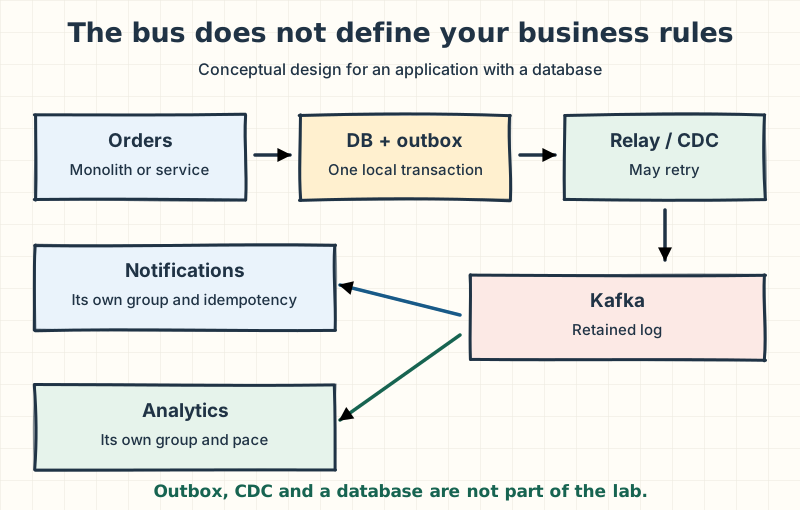
Adding a database introduces another failure window. Save the order and then publish: the process can fail between them, leaving an order with no event. Publish first and then fail to save: now the event may describe an order that was never recorded. Reversing the order does not eliminate the gap.
A transactional outbox stores the business change and publication intent in one local transaction. A relay or CDC mechanism later sends pending events. That sending can repeat, so readers still need an idempotency strategy. The Debezium outbox event router is one implementation option. The lab does not need it because it has no database write, but recognizing this boundary prevents a small teaching example from quietly becoming an incomplete production design.
10. from the Lab to an Architectural Decision
Where Kafka Fits
A monolith can own the order process and publish facts for outside applications. Microservices can use Kafka across context boundaries. A data platform can integrate sources and build continuous results. These are different uses of a retained stream, not a requirement to divide every application into small services.
DDD can help name facts and establish which context has authority over them. Hexagonal architecture can keep the Kafka client in an adapter so the domain does not depend on its classes. CQRS separates read and write models. Event Sourcing retains changes as the source of state. None of those patterns automatically appears when a program publishes JSON, and none is required to start the broker.
The Ecosystem: Add Tools for a Specific Job
This lab works with the broker and clients alone. Extra tools address specific needs; installing all of them does not turn an application into a better architecture.
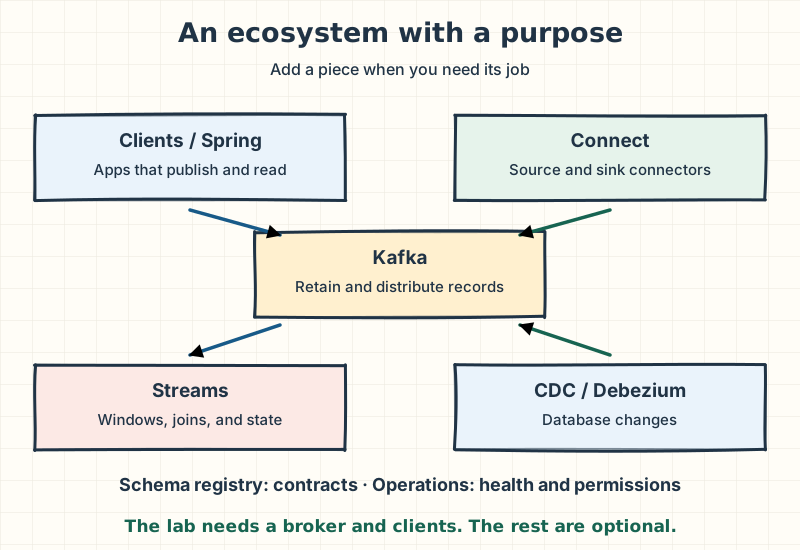
| Piece | Concrete job | Store example |
|---|---|---|
| Clients and Spring Kafka | Publish and consume from your code | Our endpoint and listener |
| Kafka Connect | Run source connectors into Kafka and sink connectors out of Kafka | Deliver records to a search engine without another custom listener |
| Kafka Streams | Java library for transformations and stateful processing | Group orders and count sales per store in five-minute windows |
| CDC, such as Debezium | Capture changes from a database log | Publish table changes or relay an outbox |
| Schema registry | Version contracts and enforce compatibility under its configured rules | Prevent removing a field that older readers still require |
| Operations tools | Explore topics, measure health, and manage the cluster | Investigate lag, permissions, or a partition without a leader |
Connect has its own runtime and tasks. A source connector reads another system; a sink
delivers to one. Streams runs inside your application: it is neither another broker nor a
SQL engine required for consumption. Its windows, joins, and state stores handle calculations
that a simple println does not need. Both belong to Apache Kafka; see the official
integration overview and
processing concepts for their boundaries.
CDC means Change Data Capture. Capturing “a row changed” does not automatically define a
domain fact such as PedidoCreado: you need a contract and a decision about which change
represents it. An outbox expresses that intent inside the business transaction; CDC can
transport it. Debezium documents that change capture
as a separate project, as are schema registry products and many
administration interfaces. Kafka does not itself validate our JSON against a business schema;
clients, tools, and agreed policies carry that responsibility.
Contracts Across Deployments
Consumers do not necessarily update at the same time as producers. Adding an optional field
and renaming a required field have different consequences. Changing what creadoEn means can
break a calculation even if every JSON document remains syntactically valid. Compatibility
has both structural and semantic dimensions.
Assign ownership of each topic and a way to announce changes. Document valid examples, identity, time conventions, optionality, and personal data. A schema registry can automate some compatibility checks for formats such as Avro, Protobuf, or JSON Schema; it is not a mandatory part of the broker and does not replace agreement between teams. Confluent Schema Registry compatibility rules provide one concrete example of these external policies.
Keep old readers and old records in mind. A replay may encounter several generations of producer output. If a deserializer only understands today's format, live traffic can work while reconstruction fails halfway through history. Test with genuinely older event forms, not only the happy-path sample emitted by the latest application build.
Security, Capacity, and Operational Signals
The lab uses PLAINTEXT on a local interface. A real environment needs explicit decisions about encryption, authentication, authorization, and network access to listeners. The security overview and ACL reference cover different responsibilities. Being able to connect does not mean a client should be able to read every topic or use every group.
For a first storage estimate, multiply incoming bytes per second by the retention window and replication factor. Then account for compression, indexes, metadata, headroom, and cleanup behavior. Treat that as an estimate rather than a precise reservation. For recovery, check whether readers can process faster than the live incoming rate while clearing backlog. Without spare capacity, they cannot catch up.
Useful signals include publication latency and errors, lag by group and partition, processing rate, the age of pending work, rebalances, disk usage, and replica health. The monitoring catalog helps map those concerns to concrete metrics. A lag alert without workload context can be noisy. An alert tied to a product's maximum acceptable delay makes the reason for intervention clearer.
Five Exercises to Test Your Model
1. Two purposes. Notifications and analytics must both receive every purchase. Would you
give them the same group.id? Explain the outcome if you did.
Solution
I would use separate groups. A shared group divides partition ownership and work; it does not give every application a copy of every record. Separate groups preserve independent progress and let one purpose rebuild without moving the other's position.
2. The rewind that did not happen. You restart a group with earliest, but it does not
reread old records. What should you inspect before blaming retention?
Solution
check whether that group has valid committed offsets. earliest does not reset
them. A new group is a simple replay experiment; changing a real group's progress requires a
deliberate administrative procedure, with consumers stopped when the operation requires it.
3. The duplicate email. The email was sent, the process exited before its commit, and the email was sent again after restart. Which guarantee was missing?
Solution
the external effect needed protection against repeated delivery. That requires stable identity and a strategy that coordinates deduplication and effect according to the destination's capabilities. Producer idempotency and a later offset commit do not make an external email atomic with Kafka progress.
4. The fourth consumer. One topic has three partitions and four members in the same group. Does the fourth process guarantee more processing capacity?
Solution
no. The conventional model used here has only three partitions to distribute. A hot key can further concentrate work on one partition. I would inspect distribution and processing time before adding processes.
5. The order with no event. An application saves an order and exits before publication. Does publishing first fix the design?
Solution
it changes the failure window but does not remove it. I would consider an outbox written with the business change in one local transaction and a recoverable relay. Consumers would still need idempotency because outbox publication can repeat.
A Glossary to Return to
| Term | The question it answers |
|---|---|
| Event | What fact are we communicating? |
| Topic | Which named flow does it belong to? |
| Key | How do we relate and partition its records? |
| Partition | Which ordered sequence stores it? |
| Offset | Where is it within that sequence? |
| Broker | Which process serves and stores partitions? |
| KRaft controller | Who coordinates cluster metadata? |
| Group | Which readers share assignment and progress? |
| Commit | Where should the group resume? |
| Retention | What history remains available under the policy? |
| Replay | Which available records do we want to traverse again? |
| Lag | How far is progress behind the end of the log? |
| ISR | Which replicas are considered in sync? |
| Idempotency | What prevents repetition from multiplying an effect? |
The Discussion I Would Take Back to the Team
| Question | What still needs designing if you cannot answer |
|---|---|
| Do we need independent readers and replay? | The reason to choose a retained log |
| Which order does the business require? | Keys, publication, and reader concurrency |
| How far behind may a group fall? | Retention, capacity, and alerts |
| What happens with duplicates? | Identity and effect protection |
| Who owns the contract? | Responsibility and evolution |
| Who restores a broken flow? | Operations and incident procedures |
If you can answer these, your Kafka discussion has a firmer foundation than a list of popular technologies. You can adopt it, trial an alternative, or postpone it for a specific reason. That judgment is part of learning the tool too.
Now look at your own application: which fact needs sharing, who should be able to read it again, and what would those two answers lead you to choose today?